Monday, August 16, 2010

Mojigangas around San Miguel de Allende

You can not go to a festival or a wedding procession in San Miguel de Allende without seeing a Mojiganga! This rather crude Mojiganga is about 10 to 15 feet tall. This stylish Mojiganga is for sale in one of the shops just off the jardin in San Miguel. The Mojigangas were brought over to the new world from Spain in the 17th century. They were originally made to draw people to religious festivals. These huge paper maiche figures are made in the image of saints, devils, political figures, a blushing bride and groom, busty ladies and familiar figures around town. They are meant to satirize and poke fun at them.

This wedding couple was going through the jardin in San Miguel along with a band and a donkey with basket saddle bags on his back that had cups and tequila in it. The party was just starting.

One of my groups that were on one of my guided tours of San Miguel were fortunate to see this.
The Mojiganga's head and bust are made of papier mache and cardboard built on a frame which rests on the dancer's shoulders. The paper mache parts are decorated with colorful paint. Such faces with their overly made up eyes. They are draped with colorful outfits with just a small slot in the front for the dancer to see out of.

It was hot out and I bet the "dancer" of the Mojiganga was sweating up a storm.

This sexy Mojiganga was part of a huge parade. You can see the head of the "dancer" peeking out at her crotch. How funny is that!
A fiesta or parade in not complete without a Mojiganga or two!

Friday, August 13, 2010

My beloved town, San Miguel de Allende

This is one of the many shots I have taken of the Parroquia (the parish church) and the jardin (the main plaza) in San Miguel de Allende.

I shot the back part of the Parroquia from the rooftop of one of the buildings on the jardin with my telephoto lense. There is something exotic, even romatic about this photo. It is just so old world to me.
Plaza Civica is one of my favorite plazas to hang out in... There is always so much to see.
One of the old, stately mansions in the historic center of town.

Click on the below for a lovely video on San Miguel. You will want to pack your bags immediately and meet me in the jardin!

Wednesday, August 11, 2010

A morning at the Denver Botanic Gardens


It was a gorgeous day in Denver, a bit hot, but my husband and I went over to the Denver Botanic Gardens right when they opened. We had never seen the gardens look so beautiful.

The Gardens is host to 20 sculptures by British artist, Henry Moore (1898-1986). Moore is famous for his abstract monumental sculptures. The above is called Oval with Points (1968-70). It is just so striking against the Colorado blue sky.
All 20 of the sculptures are from the Henry Moore Foundation that is located 35 miles north of London. Moore was inspired by nature. From rocks, bones, pebbles, shells, pieces of wood.... Many of his sculptures are reminiscent of the landscape and rolling hills in Yorkshire, his birthplace.
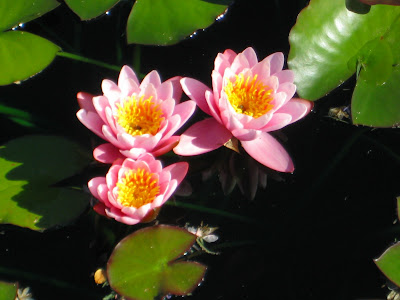
The water lilies were such a pretty sight, ranging in so many colors. Soft pale pink, brilliant red, hot pink, lavender....
"Reclining Figure" (1951)
"Reclining Figure" was heavily influenced by this Tolec-Mayan figure that he had seen at the Louvre.
I love how the sculpture takes on a new life as you view it from a different vantage point. The tree line appears like a sea of waves in the background and plays off the curves of the sculpture.
We walked all around the gardens. I loved the pattern of the rocks in this little path. Reminds me of the fabulous stone work that I see everywhere when I am at my home in San Miguel de Allende.With the death of his mother and the birth of his daughter, Mary, in 1946, Moore concentrated more on family. He expressed this in his work by producing many "Mother and Child" pieces.
Although, reclining figures were still a prominent subject in his art. I love the bold simplicity of this lady, but at the same time, her delicate poise.
This organic shaped sculpture is quite breathtaking in its setting especially with the reflection of the sculpture and the trees in the water amongst the water lilies.
Another view of this magnificent sculpture.
It was a spectacular show in a beautiful setting. I am anxious to go back with my camera in tow when we have our first snow. I'll keep you posted!
Moore in the Gardens
Denver Botanic Gardens
The show ends January 31, 2011.

Monday, August 9, 2010

Los Pimientos de Padron

When I am in the market in San Miguel de Allende, Jalapenos, Serranos and Poblanos are my fresh peppers of choice. But when I am in Spain, there are two peppers that I just adore. I actually covet them. One is the Piquillo pepper, the other is the Padron!

"Los Pimientos de Padron" are grown in Padron, a municipality in the province of Coruna in Galicia, Spain. About 33,000 pounds are grown in Padron every year between June and September. In 1979, the town of Herbon had its first fiesta honoring the Padron pepper. Since then, it is held the first Sunday in August and it is celebrated at the town's Franciscan convent. For it was the Franciscan monks who brought the first pepper seeds from Mexico back to Spain in the 1500's.
I bought this seed packet from a vendor on Las Ramblas in Barcelona, Spain. I have tried several times to germinate the seeds, but nada, nothing happened.

The next step, besides getting on a plane, flying to Barcelona and going to one of my favorite tapas joints, I ordered two pounds of the Padron peppers from La Tienda (a mail order catalog specializing in Spanish products).
The level of heat varies from one pepper to the other. It is said that the earlier harvested Padrons are milder in "heat" than the ones harvested at the end of the season. "Los pimientos de Padron, unos pican y oustros no." (The Padron peppers, some of them hot, and others, not."

Heat a little olive oil in a skillet. Throw in the Padron peppers and saute on high heat until they start to roast and blister. Once plated, sprinkle them with sea salt. My favorite sea salt is Maldon from England for I like the taste and flaky texture. The plate is one of my favorites that I had bought in Talavera de Reina, Spain.
I agree with the author of 1001 Foods to Die For, when he wrote about Padrons, "Many commentators have compared eating them to culinary Russian roulette. While most of them are mild, sweet, and somewhat nutty, every tenth one or so is as hot as a Jalapeno." Well, with the batch that I received, it was about every other one that was hot. But SO good!
Buen Provecho.

Friday, August 6, 2010

A Stunning Serape Collection at the Bellas Artes in San Miguel de Allende

Way before the arrival of the Spaniards to Mexico, a type of serape was woven in Mexico called the tilmatli. There were two types, one woven with leather, feathers and dyed threads worn by nobleman and the other woven of cotton worn by the common man. It was not until the arrival of the Spaniards that the serape changed for ever. The pedal loom was introduced along with sheep (for wool). By the 1800's, serapes (also known as classic saltillos) were first worn by wealthy hacienda owner's. Later they became a common piece of dress by townsfolk, workers and horsemen. They had a multitude of uses, worn on ones shoulders, pillows, blankets, rugs, displayed on the walls, spread out on the ground at markets to display ones wares.... Men also wore them to dances or to sing a seranade.

The Bellas Artes in San Miguel had a stunning serape collection on display from the collection of Mayer and Susan Shacter. Mayer, an antique dealer, has an extensive collection of serapes and folk art in his gallery and home outside of San Miguel. He put together an exhibit to commemorate Mexico's bicenntenial celebration and its main focus is on the flag serapes or nationalistic serapes.This "pictorial serape" are the most difficult to find. I particularly love the subject, an image often found on old Loteria posters, "a la fiesta de mi puebla."
Many of these serapes were created over 100 years ago around the same time as the centennial celebration of Mexico's Independence from Spain. These above are from Saltillo in the state of Coahuila.
The Aztec myth of the eagle holding a snake perched on a prickly pear cactus (nopal) was the design chosen for the Mexican flag. The red symbolizes the blood of it fallen heros, green hope and white national unity.
Different colors and designs vary from different regions; Oaxaca, Tlaxcala to Saltillo.
I was intrigued by the geometric designs on the outer border and then the more organic designs
that surround the eagle. The colors are magnificent too. This serape was woven in Oaxaca around 1910. Serapes from the Oaxaca area were known to have large central elements such as the Aztec calendar, flowers and animals.
Such a diverse collection. The two serapes in the corner are from Saltillo. Saltillo serapes are woven fine, tight and thin with elaborate designs.
This colorful serape is from San Miguel de Allende. Thin, fine and tight weave. Usually with a full diamond or a rounded medallion in the center.

I studied weaving at the Instituto Allende when I first came to San Miguel and being an interior designer, I love textiles. This show was exceptional!

Wednesday, August 4, 2010

La Calaca, a Folk Art Store in San Miguel de Allende

Evita Avery owns La Calaca where you can find the best antique and new folk art. Evita was raised in northern Mexico near Muzquiz in the state of Coahuila on a cattle ranch. As long as she can remember, her mother filled their home with folk art that she had collected all over Mexico. Evita, fluent in English and Spanish, worked at the Museum in San Antonio, Texas in the their folk art department. She has been acquiring and selling folk art for over 26 years. Twenty two years in San Miguel! La Calaca is full of antique pieces, some contemporary pieces and some by the Grand Masters of Mexico.

The old, round lacquered tray is from the state of Michoacan. They have been made in the same village for over 450 years and the older ones were painted with powdered pigments which gives them the most beautiful patina. Laquerware originated in the Orient and it was Bishop Don Vasco who in 1538 organized lacquer guilds which resulted in some of the most outstanding furniture.
The delicacy of this crowned nun in clay is breath taking. She was made by an artist from the state of Michoacan.
Photosculpture is a technique that started in Mexico City in the 1930's. This technique combines painting, sculpture and photography.
These green angle candelabras are from the remote village of Patamban in the state of Michoacan. This village is also noted for their pinas, pineapple shaped jars used to store both water and tepache (a drink made from pineapple, pulque, water & cloves.)
This is an "Ex-Voto" or "Milagro Board." These Milagros (miracles in Spanish) are left in churches next to the saint or virgin that one had petitioned in thanks to an answered prayer. This is often done in the Roman Catholic Church along with a candle. For example, the milagro of the cow on the bottom left would have been left in the church because a cow could have been very sick and the farmer might have petitioned to Saint Blaise (patron of sick cattle) for help.
A colorful collection of antique Guatamalan textiles. Many of them are huipils (traditional blouses.)
Ceramic papier mache doll forms from the early twentieth century. (I wrote about the papier mache dolls, Lupitas, on July 16)
The papier mache skeleton figures are made by the Linares family from Mexico City. The Linares family has made papier mache figures since the 18th century and are Grand Masters of Mexican folk art.
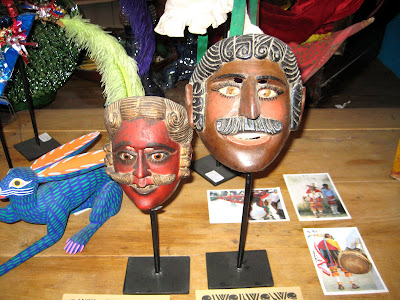
These Guatemalan masks are so different and I love how Evita has them displayed on the iron stands that she designed and had made right in town. The mask on the left is worn for the "dance of the conquest" and the mask on the right is worn for the "dance of the Mexicans."
The strikingly, handsome home altar saints are from the nineteenth century. They are articulated so they could be dressed in a variety of clothes.
I am partial to this old dowry chest made out of red cedar. It could have been mine since it has my initials on it!

Stop in and say hello to Evita for me. She is a wealth of information on Mexican folk art! Or if you are looking for something in particular, email her at thereallacalacasma@gmail.com

La Calaca
Arte Popular
Mesones 93
San Miguel de Allende
(415) 152 3954

Open: Monday - Saturday
11:00 - 2:00, 4:00 - 6:30

Monday, August 2, 2010

Flor de Calabazas are so GOOD !

When San Miguel de Allende has a few days of rain along with some warm weather, the squash vines start blooming out in the campo (countryside) and that makes me very happy. The women from the campo come to the open market in San Miguel and sell bunches of the Flor de Calabazas (squash blossoms) for only ten pesos a bunch(less than a dollar.) Stuffed and fried, they are some of my favorite things to eat!
I have taken the stems off and pulled the pistils out. I carefully put a small tablespoon size of goat cheese along with a sliver of jalapeno into the squash blossom. Then I gently squeeze the blossom to adhere to the goat cheese.

I dip each blossom into a beer batter.

Beer Batter:
1 cup flour
1 teaspoon salt
dash of cayenne
1 1/4 cups pale beer (Corona, Indio - one bottle is adequate)
Fry in 350' oil.
It is such a light, crisp batter! Drain on paper towels before plating.

I served the Flor de Calabazas with a roasted tomato salsa. I toasted a few plum tomatoes, a serrano, a few thick slices of onion and a garlic clove in its skin on my comal (a Mexican griddle.) Put all the ingredients into a blender (remove the skin from the garlic) along with some cilantro and salt and mix until slightly chunky.

I can not think of anything better than being up on my mirador, sipping a cold cerveza, snacking on a few stuffed, fried Flor de Calabazas as I watch the lights of the Parroquia and the Monjas Churches go on with mariachi music wafting in the air. Life is good.

Buen provecho y salud!