Friday, August 19, 2016

Rhythm & Roots: Dance in American Art exhibition at the Denver Art Museum

Rhythm and Roots is certainly a different exhibition and concept.  The show tells a story of the influences, evolution and traditions of dance in the United States with a collection of drawings, paintings, photographs, sculptures and costumes dating from 1830 to 1960.
Dances by Arthur Bowen Davies - 1914.  I love the movement and colors of this particular painting.  Forgot to get a better photo, there was a tour at the moment and I had to shoot around a big crowd.
The Harvest Dance - Joseph Henry Sharp - 1893.  
There was a section showcasing ceremonial and rituals dances of the American Indian as a big part of their spiritual life.
Ghost Dance by Oscar Howe - 1960.  Howe's abstract American Indian dancer painted as red flames makes a strong statement of the ongoing relevance of the Indian's culture in to days society.
Indian Dancers by Jan Matulka - 1917 is a great strong piece.  You need to step back to really appreciate its movement.
There is a section of paintings concentrating on the migration of Europeans to the states.  
The Sidewalk Dance by  John George Brown - 1894 - shows children dancing a traditional step to the man playing the hurdy-gurdy.  A dance step common to the Irish, Germans, Italians...
Dancers by Charles Alston - 1949.  A great jazzy movement to this painting.
The Charleston by Frank Myers - 1926.  One can just feel the dancers swinging around on the crowded dance floor doing the Charleston.
Dancing Lesson by Raphael Soyer - 1926.  I love the folk art sense to this painting.  It is a memory of Soyer's of his sister teaching his twin brother to dance while his mother puts down his Yiddish newspaper to watch along with the rest of the family.  The youngest brothers adds a little music by playing his harmonica.  Truly is a piece of history portraying three generations.
Dancer and Gazelles by Paul Manship - 1916.  I particularly like Manship's work.  One of my favorite pieces of his can be found at the National Museum of Wildlife in Jackson, Wyoming  titled Indian and Pronghorn Antelope - 1914.  He studied at the American Academy in Rome where his style was strongly influenced by the Roman, Greek and Egyptian works.  Such refined, delicate work with a beautiful Art Nouveau style.  
Youth by Arthur F. Mathews - 1917.  He beautifully portrayed the nine muses of Greek mythology.  Urania, the muse of astronomy leads the group clanging her cymbals while dressed in a gold-colored skirt decorated with the signs of the zodiac.
The Jolly Flatboatmen by George Caleb Bingham - 1846.  The artists celebrated the life of the working men who transported supplies and goods along the Missouri River.  To take a break and entertain each other as they would dance a jig or two.  This whole scene reminded me of the old 1950's musical, Seven Brides For Seven Brothers;  It's a story set in 1850 Oregon, when a backwoodsman brings a wife home to his farm and his six brothers decide that they want to get married too.
Plumes by Walt Kuhn - 1931.  Kuhn was most famous for his portraits, especially those of circus performers and vaudeville entertainers.  He would use them as models and painted them differently of what one would see on stage, the models seemed detached from their cheerful performing arena and to be staring intently out at the viewer. 
Portrait of Katherine Dunham by Werner Philipp - 1943.   Dunham was an anthropologist and one of the greatest modern dancers of the time in the United States and Europe.  She had an unique style that was influenced by her research of Afro-Caribbean dance combined with jazz and ballet.   
La Carmencita - John Singer Sargent - 1890
The Spanish dancer, Carmencita (also known as the Pearl of Seville), was famous in the 1980's in Spain and France.  Her popularity was so immense, that when she came to New York, she was inundated with requests for private performances.  Sargent certainly captured her energy with this dramatic pose and elegant dress.
Terpsichore and Euterpe - David Smith - 1947
This bronze represents the strong and angular gestures of modern dancers of his time.  Terpsichore was the muse of dance and Euterpe shown playing the piano was the muse of music.
The Egyptian Dancers - Anne Estelle Rice - 1910
Inspired by the Russian Ballet's performance of Cleopatra.
Russian Ballet - Max Weber - 1916
Weber was also influenced by the Russian ballet's colorful set design as seen in the above painting.  Dance and movement was a common theme in many of his works.
In the late 1920's Diego Rivera designed many of the costumes for the American Ballet H.P.
(Horse Power).  In this ballet, the industrial skills of the United Stated meets the agricultural of South America.  A ballet that was only performed once in 1932 and was not recorded.
The Siren (Sirena/Mermaid) - Diego Rivera - 1927
I would have loved to see how the costumes were executed! 

It is an exhibition showcasing many more works that I have not even touched on.

Denver Art Museum
Exhibit runs through October 2.


Thursday, August 18, 2016

My Coffee-Toffee-Chocolate Torte is an irrisitible decadent dessert that everyone loves!

A dessert with layers of toffee-studded, coffee-flavored mousse and chocolate ganache with a roasted almond, Heath bar and sugar-cookie crust.  Truly decadent!
Coffee-Toffee-Chocolate Torte

Crust:
        1 cup almonds, toasted
6 3/4 ounces (1 container) Pepperidge Farm Bordeaux cookies
    1/2 cup coarsely chopped Heath bar, about 3 ounces
        6 tablespoons butter, melted

Ganache:
1/4 cup whipping cream
    2 tablespoons light corn syrup
    1 tablespoon instant espresso powder
    6 ounces bittersweet chocolate
   

Mousse:
3/4 cup sugar
    6 large egg yolks
1/3 cup warm water
   3 tablespoon
1/2 teaspoon

2 1/2 cups chilled heavy whipping cream
       2 tablespoons Kahlua
       1 teaspoon vanilla extract
1 1/2 cups coarsely chopped Heath bar (9 ounces)

For Crust:
Heat oven to 350.  In a processor, grind the almonds, cookies and heath bar.  Add the melted butter and blend until nuts are finely chopped.  Press mixture onto the bottom and 3/4 up the sides of a 9-inch spring form pan.  Freeze for 15 minutes.  Bake crust until golden, about 12 minutes.  Let cool and freeze.

For Ganache:
Bring cream, corn syrup and espresso powder to a simmer in a saucepan.  Remove from heat and whisk in the chocolate pieces until melted and smooth.  Set aside.

For Mousse:
Whisk sugar, egg yolks, water and espresso powder in a double boiler.  With water simmering, whisk mixture starts to slightly thicken.  Remove from heat.  Add nutmeg.
With an electric mixer, beat until cool and thick, about 5 minutes.

Beat the cream, Kahlua and vanilla until stiff peaks form.  Fold in the pieces of Heath bar.  Fold into cream mixture.  

Spoon half the mousse into the crust.  Drizzle half the ganache over the mousse.  Spoon remaining mousse over the ganache.  Drizzle remaining ganache in a zig zag pattern over the top.  Cover and freeze overnight.
I have a few of those squirt mustard/ketchup bottles that you find at a diner that I use to to drizzle my sauces.  I found a package of three at the World Market/Cost Plus.  It is perfect for decorating the top of the torte with the ganache.  

To serve, run a sharp knife around the edge of the pan sides.  Release the sides.  Cut into desired slices.
Can be made a week in advance.
12 - 14 servings.    


Friday, August 12, 2016

A Surprise Birthday Luncheon for Liz

Wednesday my friend Judy and I hosted a surprise birthday luncheon for our good friend Liz who is turning 80 next week.  Here I am in one of my favorite huipils that I bought in Oaxaca.
Everyone arrived early.  Liz pulled into the driveway and then I had to get a room of ladies to be quiet so she would not hear us.  Well, Liz walked into the entry, everyone yelled surprise and Liz just stood there shell shocked.  It certainly was a surprise.
We moved out to the patio and I first served Bellinis made from the delicious peaches that we can get this time of year from Pallisades, Colorado.   I also served crunchy cheddar cheese biscuits and Tomato and Watermelon Squares.  (Both recipes will be featured in my appetizer cookbook that I am working on).
 Paula, Birthday Girl Liz and Bonnie.
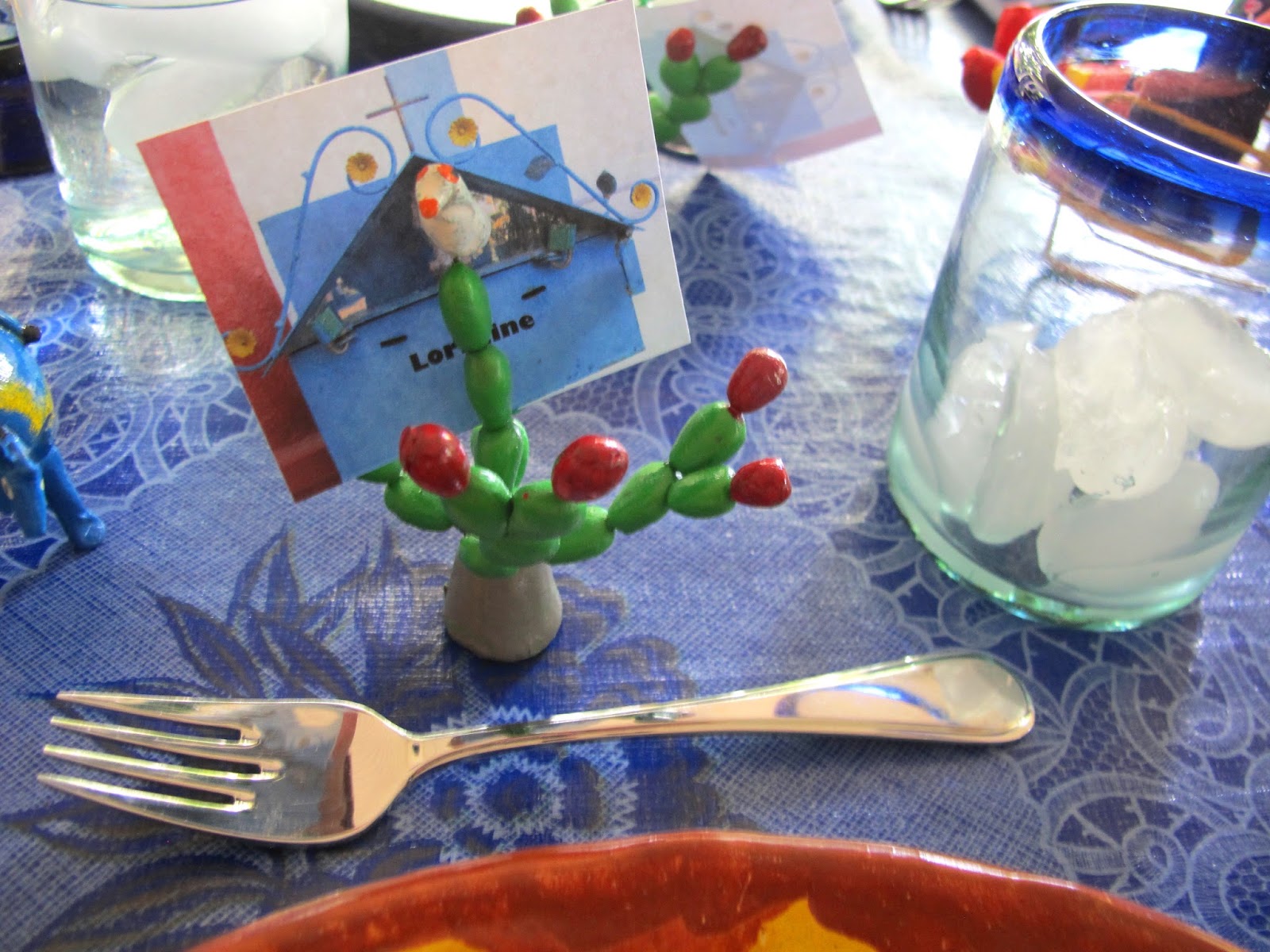
A little bit of Mexico on my table...  The blue and silver oil cloth I had bought from my friend Guadalupe who had an oilcloth line of purses, place matts, cosmetic bags, etc. called Mary Jane Bags.  Now she's founder and owner of PENZI, a very successful and creative wedding planning and event company in San Miguel de Allende.  The plates are an abstract Picasso like design that I picked up in Dolores Hidalgo 30 some years ago.  The glassware from San Miguel along with the paper mache dolls.
I love using my cotton paisley bandanas that I bought in the market in San Miguel to use as napkins.  I photo shopped this photo of Liz by adding a sombrero and made napkin rings.
Such the party girl!
The ceramic nopal cactus acted as a place card holder.
I served an arugula and mixed green salad with thinly sliced red onions, avocado, peaches and pepitas (pumpkin seeds) with a cilantro dressing.  With some dietary restrictions (no fish, no meat... at least gluten was not an issue this time) I made a Black Bean Torta that was layers of flour tortillas, sauted vegetables, asadero cheese and salsa fresca (see recipe on my upcoming next Post).
Clockwise:  Bonnie (in the orange dress), my mom Lorraine, Paula, Judy, Nancy, Liz and Lucette.  Along with the meal, I served a chilled Spanish Rose, Muga.
We finished with the most decedent dessert that everyone said they could not possibly finish but guess what, everyone did.  I will post the recipe soon.  The beauty of it is that one can make it in advance, it is frozen and will feed a big crowd.  The only downside, there are many steps to the recipe.

It was a great day with wonderful weather, delicious food and drink and good friends.


Monday, August 1, 2016

A morning at the magnificent Maya ruins in Palenque


The name Palenque is the Spanish word for fortification and also known as Otulum in Mayan meaning a "strong house."  When entering the archeological site, your first stop is at Temple XII, Temple XIII and the Temple of Inscriptions, known as the Funerary Corridor for their deathly ornamentation and content.  Just look at the figures to the right and compare it to the magnificent scale of these temples.  
The ancient city's original name name was Lakam Ha, or Big Water, referencing the many streams and springs in the area.  It was only this last Monday that archaeologists discovered an underground water tunnel that was built under the Temple of Inscriptions which is home to the tomb of the ancient ruler Pakal.
It was not until the 20th century that the Mexican Institute of Anthropology took over the restoration at the site and in 1952 the funeral crypt in the Temple of Inscriptions was discovered.  This discovery was comparable to similar ones made in Egypt!
It is believed that the temple was specifically built atop the springs between 683 and 702.  Water was tunneled from under the the funeral crypt out to the spacious esplanade in front of the temple, thus allowing a path for Pakal's spirit to reach the underworld.  
Palenque was probably founded in the 4th century B.C..  But the period of splendor was between the 7th and 8th centuries A.D..  The Palace above is one of Palenque's most impressive complexes.  It is built on a platform that is 33 feet high and covers an area larger than a city block.  This was the home of the ruling family and his court. 
It was built during the reign of Pakal but it was his successors that added houses, courtyards and the famous tower in the 8th century A.D..  
The majority of the Palace's facade was painted red and blue.  The north side of the tower was adorned with white stucco along with floral motifs.
Many of the buildings had decorated facades and interiors with figures, stucco friezes  and embossed tablets.
The south group of temples consist of three.  The Temple of the Sun is the smallest of three but the best preserved.  Built on top of an elevated bluff, its pillars, facade and roof comb have elaborate stucco decoration.
A view of the the Temple of Inscriptions from a far.  What a beautiful setting right in the middle of the jungle.  Only a small portion of the buildings have been recovered.  There are over 200 buildings in this 270,000 square foot setting and I have just showcased some them.  It truly is a spot not to be missed, one not over run with tourist and one that I will take my group to the end of February in 2017 where we will spend the entire morning exploring the site followed by a visit to the museum which is located at the entrance of the ruins.  The museum contains an incredible collection of stucco and stone artifacts found at the site including relief carvings and hieroglyphic panels in pristine condition. 

Interested in joining me on my Magic World of the Maya Tour.
The dates are February 24 - March 3, 2017 and I have a few spots left.
Please contact me at robindsg@aol.com

Thursday, July 28, 2016

The Agua Azul in Chiapas

Between San Cristobal de Las Casas and Palenque is the Rio Xumal-Ha (River of Blue Water) also known as the Agua Azul.
This beautiful spot showcases numerous cascades of water flowing down a limestone ridge forming large pools and small streams.  The blue-teal color of the water was almost luminescent. 
 I did not have time to swim but there were many that were enjoying the various pools.
Many of the largest pools have been shored up to allow swimmers easier access to the water and for areas that children could wade.
There is a wide paved path that runs from the parking lot to the falls along with various observation points.  Unfortunately like most tourist attractions, you will find a variety of stalls lining the path selling souvenirs, food, t-shirts...
Driving towards Palenque, I was able to pull off the road to see the Tulija River.  What a gorgeous spot.
This is just one of Chiapa's natural wonders we will be exploring in February of 2017.  I still have a few spots left should you want to join me.  February 24 - March 3, 2017.
I may be reached at robindsg@aol.com

Tuesday, June 28, 2016

Cruising up the Grijalva River through the breathtaking Sumidero Canyon


The Canyon de Sumidero is one of Chiapa's natural wonders in the countryside a few kilometers east of Tuxla Guitierrez with the Rio Grijalva (or the Rio Grande de Chiapas) flowing northward thorough it.  The Chicoasen Dam was completed in 1981 at the canyon's northern end creating a narrow, 35 kilometer-long reserve.  The canyon was tens, even hundreds of meters deep before the dam was built.
It was a beautiful morning when I boarded the launch down at the river in the small town of Chiapas de Corzo.
Heading up the river, we entered the canyon's mouth as we passed under Highway 190, one that I had driven on to reach Chiapas de Corzo. 
It was early spring and some of the trees were just starting to leaf out.  These particular walls had an interesting assortment of cacti growing out of the crevices.
Along the way you will see a variety of birds - Herons, Egrets, Cormorants, Vultures and King Fishers and an occasional group of Spider Monkeys hanging out in the trees.
The canyon walls began to grow in height.  In some areas, they reach a height over one kilometer.
The rainy season had not started so the vegetation was not as green as it will be in the months to come.  There are many caves and interesting rock formations.  This lush triangle of moss and vegetation cascading down the side of the canyon's wall is known as the Arbol de Navidad (Christmas Tree).
The boat takes over an hour to reach the dam with stops on the way to check out the wildlife and other interesting sites.  
We stopped and waited as a boat approached, a mini-store on the water selling water, soft drinks, cut up jicama and other goodies to tempt the thirty tourist.  What a handsome young man helping his mother out that day.
Back in Chiapas de Corzo, I was impressed by the main square with elaborate brick, octagonal shaped foundation and fountain that was built in 1562.   With its Mudejar and Gothic features along with flying buttresses, it is said to resemble the Spanish crown.  Beautifully maintained, the red-orange brick displays an intricate design. 
It's a pretty little village and the place where I will be staying with my group our first night in Chiapas.  We arrive around 6:00pm into the Tuxtla Guitierrez airport and my driver will take us to our hotel just off the main square.  The next morning will be an exciting boat trip up the Rio Grijalva.  Then on to San Cristobal de Las Casas where we will have lunch and later tour of the town.

If interested in joining me, check out my post dated 5/4/2016 and send me an email with your name and mailing information to robindsg@aol.com.  Then I can mail you a detailed itinerary along with pricing.  I have only a few spots left.  It's an unique trip and nothing like my past adventures.


Wednesday, June 8, 2016

Sculptures at the Denver Botanic Gardens

It was a beautiful morning when my husband, Len and I went over to the Denver Botanic Gardens to see the the newest exhibition, Stories in Sculpture, a selection of sculptures from the Walker Art Center Sculpture Garden in Minneapolis.
Walking Man by George Segal - 1988 - A thoughtful stance, with slightly hunched shoulders and hands in his pockets portrays a solitary figure, a sense of isolation.  Segal started out as a painter and then moved on the sculpting.  His figures lack color and detail, portraying almost a ghostly effect.
It was the perfect setting for Walking Man.
The flowers were spectacular, especially the poppies.
I love Debra Butterfield's horses.  The Denver Art Museum has several.  Last year there was a show dedicated to just Butterfield's horses at the gardens.  (See posts dated:  6/30/2105 and 7/1/2015).
Nike by Saul Baizerman - 1949-1952.  Nike in Greek mythology is the goddess of victory who often helped Zues with his fight against the Titans.  Often depicted without wings.  Baizerman from Russian with his academic training was influenced by mythological themes.
Standing Figure by English artist and sculptor, Henry Moore - 1961.  His works are usually abstractions of the human figure with void spaces which make the viewer fill in the blanks.  Standing Figure, an edition of six, reaches a height of 11'5" and weighs 1,200 pounds.
Ice Plant (Delosperma Ashtonii Blut) was almost fluorescent in this lighting.
One of my favorite sculptures was Dawn Tree - 1976 - by Louise Nevelson.  An American sculptor who immigrated from Russian in the early 20th century was best known for her monumental outdoor sculptures.
Young Woman by Georg Kolbe - 1926.  He was the leading German sculptor of his generation.
The Peonies were in their prime.
Horseman - 1949 - by Marino Marini.  An Italian sculptor who was particularly famous for his series of stylized equestrian statues.
Hare on Bell on Portland Stone Piers - 1983 - by Barry Flanagan, a Welsh sculptor known for his dramatic, monumental bronze hares that just leap to life.
Theater Set Element from Judith - 1950 - by American artist and landscape architect, Isamu Noguchi.  He was also famous for his set design.  But I know of him best for when there was a collaboration with Herman Miller and Noguchi, George Nelson, Paul Laszlo and Charles Eames to produce a collection of some of the most influential body of modern furniture ever produced.  Including the iconic Noguchi Table which is still in production today and one that I sold to one of my design clients a few years ago.
It is a wonderful sculpture exhibition.  Even though there are 13 pieces on display in the gardens, I chose to showcase the ones that I particularly liked.  The exhibition is here until October 2, 2016.

Denver Botanic Gardens
10th and York Street
Denver, Colorado
www.botanicgardens.org