Last time I was in Oaxaca City, I came across a stall in the market that was selling this colorful oil cloth with Catrinas, skulls, flowers and paper picados on it. I could not resist and bought three meters to use as my tablecloth for my next Day of the Dead dinner party.
Highly varnished clay skulls from San Bartola Coyotepec.
Keeping with the theme, I made paper napkin holders with a skull and every one's name on it. The typeface I used is called "thriller". How appropriate.
A devil tin candle holder from San Miguel de Allende
Another tin candle holder along with a clay pumpkin that I had bought at El Tianguis, the Tuesday market on the outskirts of San Miguel.
An empty bottle of KAH Reposado tequila. Every bottle is an
individual, hand crafted work of art - no two bottles are
alike. Besides the bottles being very cool, the tequila is also excellent.
I had to get the pumpkin carved to great my guests at the front door.
Special adhesive wine labels that I put over the original ones that read "Embalming Juice", "Zombie Virus" and "Spider Venom".
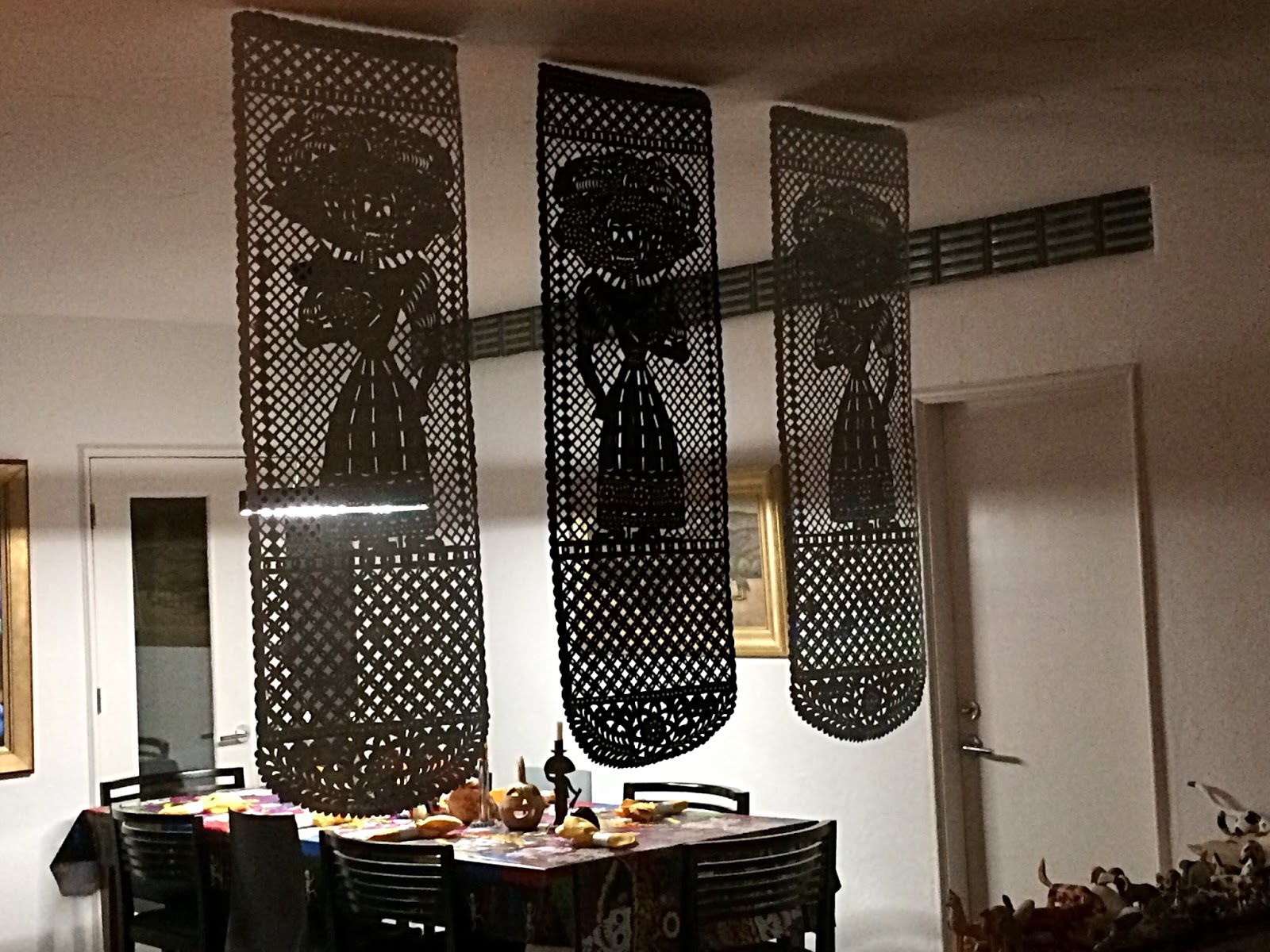
Silver and black mylar picados that I had found in the market in Oaxaca. Perfect to hang between the living room and dining room.
The main course was a 6-pound bone-in Boston butt pork shoulder. I made a paste of smashed garlic, salt, dried oregano, red pepper flakes, achiote paste and cider vinegar. I scored 1-inch deep cuts on the fatty side, then rubbed the paste all over the pork and wrapped it securely in banana leaves. I tied the banana-wrapped bundle of pork with kitchen string and let it sit in the refrigerator two days before I cooked it.
I set it on a rack in my largest Le Crueset dutch oven. Added some cut onions and jalapenos to the pot and enough water to come 1-inch up the sides. Covered the pot and baked for 5 hours at 300 degrees. After 2 1/2 hours, I turned the pork over.
The pork turned out perfect, tender and delicious. I shredded it with a fork and poured some of the braising liquid over it.
I served it with a salsa Veracruz, a cazuela of roasted poblanos and sauteed onions, and corn tortillas. Along with a spinach and arugula salad tossed with a cilantro dressing and then sprinkled with pepitas.
I have plenty pork left over to make some green chili for my next tamale dinner or two.
It was a very festive evening!
Monday, October 30, 2017
Friday, October 27, 2017
Taking the funicular up to Mount Igueldo in San Sebastian
Walking the promenade towards the west, you will take a slight detour and follow the signs to the funicular that will take you to the top of Mount Igueldo. For 3.15 Euros, you can ride the clunky old-world funicular that is pulled up the mountain by a series of pulleys and motors up to the top. It runs every 15 minutes.
Once to the top the views are spectacular.
It was off season and the Parque de Atracciones was closed for the season (children were back in school). Atop Mount Igueldo, there are individual rides and games like the canal seen above that surrounds the property where you can take boat rides.
This is the paddle that creates the movement in the water to propel the tiny boats.
A view of the coastline looking west.
The Torreon de Monte Igueldo is a fortified 16th-century lighthouse. It is no longer functioning but it offers great views.
Once you reach the area with all the attractions, it is like stepping back in time. It could be a set from an episode of the Twilight Zone. Check out the big gorilla face as the entrance of the Casa de Terror.
A big ole slide...
A mini train ride that weaves in and around these toad stools and gnomes.
A big labyrinth.
And bummer cars. I could just see my group in these after a few bottles of Cava! Watch out.
Where are the Jetsons?
Would have loved to have had my husband with to try this one out. He might have broke it.
A sign promoting another ride.
We waited for the next funicular to come up so we could go back down.
Once to the top the views are spectacular.
Part of my group of ladies.
I was so impressed by the beautiful and lush Hydrangeas.This is the paddle that creates the movement in the water to propel the tiny boats.
A view of the coastline looking west.
The Torreon de Monte Igueldo is a fortified 16th-century lighthouse. It is no longer functioning but it offers great views.
Once you reach the area with all the attractions, it is like stepping back in time. It could be a set from an episode of the Twilight Zone. Check out the big gorilla face as the entrance of the Casa de Terror.
A big ole slide...
A mini train ride that weaves in and around these toad stools and gnomes.
A big labyrinth.
And bummer cars. I could just see my group in these after a few bottles of Cava! Watch out.
Where are the Jetsons?
Would have loved to have had my husband with to try this one out. He might have broke it.
A sign promoting another ride.
We waited for the next funicular to come up so we could go back down.
Once that funicular leaves, there is not guard rail, nothing to prevent someone from falling into the big gap. We all backed up against the wall waiting for out turn.
It's a funky place with incredible views and I bet it would be a lot of fun when all the rides are up and running.
Tuesday, October 24, 2017
The Comb of the Wind sculptures in San Sebastian
Another morning we walked the opposite direction from our hotel towards Mount Igueldo. Every morning the beach is dragged and seaweed is being collected. There must have been some storms out at sea, for I have never encountered hardly any seaweed in the past. The water is normally crystal clear.
At the very western end of the Promenade and La Concha Bay, you will find El Peine del Viente (The Comb of the Wind), a collection of three sculptures by Eduardo Chillida arranged as an architectural work by the Basque architect Luis Pens Ganchegui.
These monumental steel sculptures, weighing 10 tons each, are embedded in the natural rocks rising from the Cantabrian Sea. Completed in 1976, It's a marriage of art and landscape where the ruggedness of the sea meets the strength of the iron sculptures.
Jorge Oteiza was a Basque sculptor born in San Sebastian who examined the nature of space and emptiness in monumental minimalist sculptures that were very influential in the art world of the mid-20th century.
Octavio Paz wrote that in Chillida’s work "iron says wind, wood says song, alabaster says light — but all say the same thing: space".
It's a beautiful spot!
Friday, October 20, 2017
A pretty stroll around Mount Urgell in San Sebastian
One morning, kinda misty out, I headed out with my group towards the marina to walk around Mount Urgell. What a view from my hotel window.
There is a huge Christ up on the top of the hill that you can climb up to.
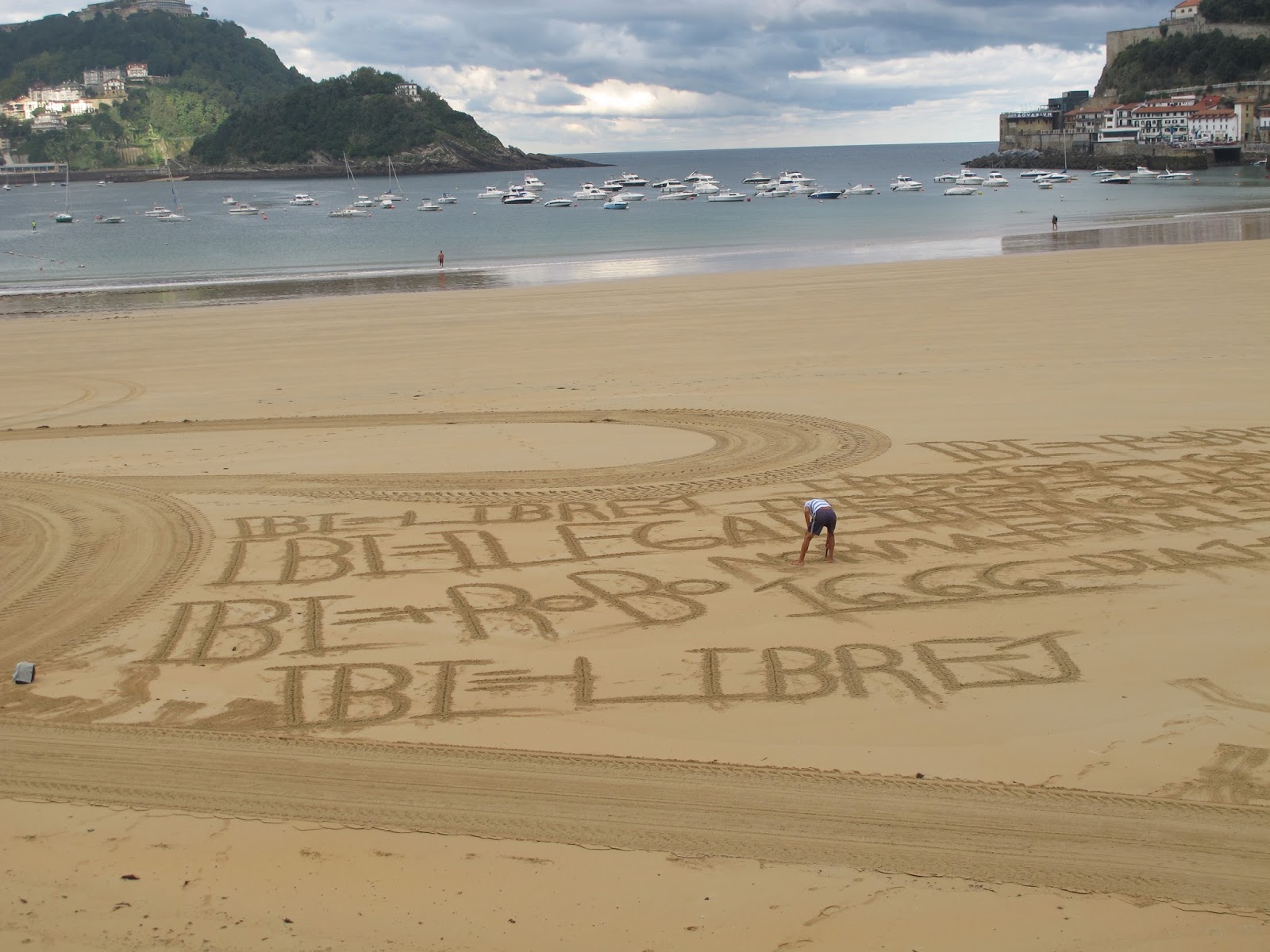
On the way we noticed a man writing in the sand, I would assume making some political statement that will soon be erased by the incoming tide.
We passed by a quaint, little marina.
Loved the tile facade on this building. It glimmered in the sun, almost like fish scales.
One house had dyed or painted the wine corks and hung them decoratively from the eaves. I love it but I sure it would be very time consuming to make.
Great art work on this poster advertising an exposition on sea toys at the Aquarium.
A view of the Santa Clara island that has a tiny beach and when it's tide, most of the beach disappears. Beyond the island is Mount Igueldo. If you follow the rock stairs down to the water and then out, you will see a small figure, a man paddle boarding. He started at the beach by our hotel, proceeded to go out into the ocean and around Mount Urgell to the Zurriola beach, which is noted for its surfing, and then back to where he started. Talk about core strength!
Laura stopping on the Paseo Nuevo to take some photos of the beautiful scenery. It's spitting rain here and there but the sun is trying to come out.
Then we come upon the striking sculpture, Construccion Vacia (Empty Construction), by Basque artist, Jorge Orteiza (1908 - 2003). It's like a wild window with its view out into the rugged sea.
And the sea can be rather ominous as the sign warns.
The waves were rather tame the day we were walking on the Paseo Nuevo.
But a few years ago the waves were really crashing up onto the walkway.
Making the big loop, we ended up in the plaza in front of the San Telmo Museo which features the Basque culture and society.
What totally amused us were a group of little girls playing a game at recess.
Totally oblivious to any one else except on getting the bandana from the ring leader.
It's a perfect morning walk and you will see many of the locals doing just that.
There is a huge Christ up on the top of the hill that you can climb up to.
On the way we noticed a man writing in the sand, I would assume making some political statement that will soon be erased by the incoming tide.
We passed by a quaint, little marina.
Loved the tile facade on this building. It glimmered in the sun, almost like fish scales.
One house had dyed or painted the wine corks and hung them decoratively from the eaves. I love it but I sure it would be very time consuming to make.
Great art work on this poster advertising an exposition on sea toys at the Aquarium.
A view of the Santa Clara island that has a tiny beach and when it's tide, most of the beach disappears. Beyond the island is Mount Igueldo. If you follow the rock stairs down to the water and then out, you will see a small figure, a man paddle boarding. He started at the beach by our hotel, proceeded to go out into the ocean and around Mount Urgell to the Zurriola beach, which is noted for its surfing, and then back to where he started. Talk about core strength!
Then we come upon the striking sculpture, Construccion Vacia (Empty Construction), by Basque artist, Jorge Orteiza (1908 - 2003). It's like a wild window with its view out into the rugged sea.
And the sea can be rather ominous as the sign warns.
The waves were rather tame the day we were walking on the Paseo Nuevo.
But a few years ago the waves were really crashing up onto the walkway.
Making the big loop, we ended up in the plaza in front of the San Telmo Museo which features the Basque culture and society.
What totally amused us were a group of little girls playing a game at recess.
Totally oblivious to any one else except on getting the bandana from the ring leader.
It's a perfect morning walk and you will see many of the locals doing just that.
Monday, October 16, 2017
La Concha Bay in San Sebastian is spectacular!
La Concha beach is very grandiose and one of the most beautiful in the world. La Concha beach is sheltered between Mount Urgell on the east and Mount Igueldo on the west. The shape of the bay explains the name "concha" (shell). It has a length
of 1,350 meters and an average width of 40 meters. I say average, since
the tides can strongly influence the size of this beach on the Atlantic
Ocean.
The elegant Art Nouveau railing of La Concha Bay is very symbolic in San Sebastian. It runs the whole length of the bay and it makes for a lovely walk. The railing was built in 1910 by Juan Raphael Alday but it was not until 1916 when King Alfonso XII officially inaugurated the railing. The construction cost about 34 Euros (5,700 pesetas at the time).
Walking west of my hotel, the Hotel de Londres y de Iglaterra, one comes upon a stately building across the street, formerly the Royal House.
In the 19th century La Concha beach was the place where Queen Isabel II came for her bath therapy, after her doctor recommended this. Soon San Sebastian turned into the summer residence of the Spanish royal family and also a place where other European royals would spend their summers.
It is in front of the former Royal House that the section of the railing is different from the rest. The round design has become oval.
You can either stroll along the beach or walk above it on the boardwalk.
The symbolic street lanterns of La Concha bay are made into little sculptures that are used as the awards during the International Film Festival which is held every August.
You can find the end of La Concha beach at the "Pico de Loro" (the so called parrot’s beak).
The "Pico de Loro" is a small passage of rocks which
disappears during high tide. Behind this “Pico de Loro” the Ondaretta beach starts, this beach is also located in the Concha bay and its border is marked by the Igueldo mountain.
An exciting event to witness is the "Day of the Dance". For one day every March , more than a thousand students of classical dance perform next to the railing.
The Basque name for a citizen of San Sebastian is Donostiarra. There is a popular saying in San Sebastian, "You're more Donostiarra than the railing of La Concha". It's a beautiful spot, one of my favorite places and every time I am here, I pretend to be a
Donostiarra.
Subscribe to:
Posts (Atom)