As I mentioned in my last post, Denver has incredible art. You just have to be adventuresome to discover some of the murals, especially in LoDo. Drive down some alleys. That is exactly what we did the other day after lunch.
I was amazed on the number of murals and the talent! Unfortunately I do not know anything about the artist.
We zig-zaged back and forth on Larimar Street and Lawrence Street and kept heading north.
Being in the alleys, sometimes it is hard to really get a good perspective of the art.
Love the colors.
Looks like a Chinese kite to me.
The next few murals were in a parking lot.
Great composition.
The art pretty much says it all.
Since I shot these photos, I am sure there are even more to be found! Enjoy.
Showing posts with label Murals. Show all posts
Tuesday, March 24, 2015
Wednesday, March 11, 2015
Magnificent murals in Queretaro!
Recently I was over in Queretaro, an hour drive from San Miguel de Allende. The Plaza de Armas was beautifully landscaped and maintained.
Also known as the Plaza de Independencia. I loved the fountain in the center of the plaza with the four stone dogs.
Just at the north end of the plaza, sits the former home of Dona Josefa Ortiz de Dominguez and her husband Corregidor (Mayor) Don Miguel Dominguez. Her husband became suspicious of her of being a trader and locked her in her bedroom. She caught the attention of a loyal servant, Ignacio Perez, by tapping her heel of her shoe persistently on the floor. She whispered her instructions through the keyhole of the locked door. Perez alerted Juan de Aldama who then made his way to the near by town, Dolores, where he found Father Miguel Hidalgo and Ignacio Allende. This was the beginning of the War of Independence.
How fitting that this structure is now the Palacio del Gobierno and it now houses three magnificent murals by Victor Caudura Rojos depicting the story of the struggle for Independence. The figures in the center, from left to right, are: Guadalupe Victoria, Ignacio Allende, Miguel Dominguez, Miguel Hidalgo, Josepha Ortiz de Dominguez, Jose Maria Morelos and Vicente Guerro. On the horse in the lower right hand corner is Augustin de Iturbide.
It was in this same building where the message was sent to start the fight for independence.
The breaking of the chains and the eagle signifies the birth of a nation.
You will find Maximilian of Haspburg and Carlotta, center, left. And notice in the center panel, the Masonic eye. Even though there are several panels, your eye automatically completes the mural as one large panel.
The village people who faced the Royalist army were willing to fight and die for the cause.
The execution of Maximilian and his two generals, Miramon and Mejia.
It was Venustiano Madero who opposed the system and started the revolution and Francisco Madero, the lawman, ending the revolution with the signing of the constitution. Emiliano Zapata is to the right, the Revolutionary hero, with his slogan "Land and Liberty."
Art is an universal language - translated through the murals, the history of Mexico, beyond any language.
Queretaro was, has been and will be, part of that history of decisive events that shaped the country.
For more on the artist:
Victor Cauduro Rojas
www.victorcauduro.com/lang1Friday, January 9, 2015
Allen Tupper- True Murals in the former Colorado National Bank Building
The Renaissance Hotel opened this last year in downtown Denver after an extensive restoration of the former Colorado National Bank building that was built a century ago. What makes this interior so special are the series of 16 original oil-on-canvas murals.
Over the years I have fallen in love with murals from the one in the library in Patzcuaro, Mexico depicting the history of the state of Michocan to the murals painted by Siqueros at the Bellas Artes in San Miguel de Allende, Mexico.
Indian Memories is a series of murals painted by the western muralist, Allen Tupper-True. He also has painted numerous murals in Wyoming and Missouri. Painted in 1925, the Indian Memories cost $18,000.
There are five triptychs that depict a different aspect of a Native American's life: Youth, Buffalo Hunt, War, Women and Art Work.
The largest of the murals, Happy Hunting Ground, is located above the porte-cochere entrance. True described this as "an attempt to suggest some of the wonderment, awe and tremendous expectation with which the Indian looked forward to the great adventure of the end of life's trail, platform, as his spirit gazes eagerly at what lies ahead".
A close up of the great chief. What a wonderful palate of colors.
Youth, located above the Club Lounge, is a few scenes of young boys celebrating their success in their first hunt.
Young boys are gathered around the crane that one of them had just killed in the hunt. In the middle-foreground of the painting is a Sioux sun symbol.
Buffalo Hunt, located above the entrance to range, depicts a hunter surrounded by smoke from his fire while dreaming of his successful hunt. The dream is filled with stampeding buffaloes stirring up the dust from the dry ground and warriors mounted on their galloping horses in pursuit.
Women is located above the reception area.
In this particular scene, an older women in sitting by the edge of a waterfall in which she sees images of her younger self, laughing and splashing water with other young maidens.
Next time you are downtown, stop in the Renaissance for a drink and take in the spectacular murals. I think you will enjoy the space also.
Renaissance Hotel
The corner of Champa and 17th Street
Downtown Denver
Over the years I have fallen in love with murals from the one in the library in Patzcuaro, Mexico depicting the history of the state of Michocan to the murals painted by Siqueros at the Bellas Artes in San Miguel de Allende, Mexico.
Indian Memories is a series of murals painted by the western muralist, Allen Tupper-True. He also has painted numerous murals in Wyoming and Missouri. Painted in 1925, the Indian Memories cost $18,000.
There are five triptychs that depict a different aspect of a Native American's life: Youth, Buffalo Hunt, War, Women and Art Work.
The largest of the murals, Happy Hunting Ground, is located above the porte-cochere entrance. True described this as "an attempt to suggest some of the wonderment, awe and tremendous expectation with which the Indian looked forward to the great adventure of the end of life's trail, platform, as his spirit gazes eagerly at what lies ahead".
A close up of the great chief. What a wonderful palate of colors.
Youth, located above the Club Lounge, is a few scenes of young boys celebrating their success in their first hunt.
Young boys are gathered around the crane that one of them had just killed in the hunt. In the middle-foreground of the painting is a Sioux sun symbol.
Buffalo Hunt, located above the entrance to range, depicts a hunter surrounded by smoke from his fire while dreaming of his successful hunt. The dream is filled with stampeding buffaloes stirring up the dust from the dry ground and warriors mounted on their galloping horses in pursuit.
Women is located above the reception area.
In this particular scene, an older women in sitting by the edge of a waterfall in which she sees images of her younger self, laughing and splashing water with other young maidens.
Renaissance Hotel
The corner of Champa and 17th Street
Downtown Denver
Thursday, July 31, 2014
History of the Westside Community Mural in Denver
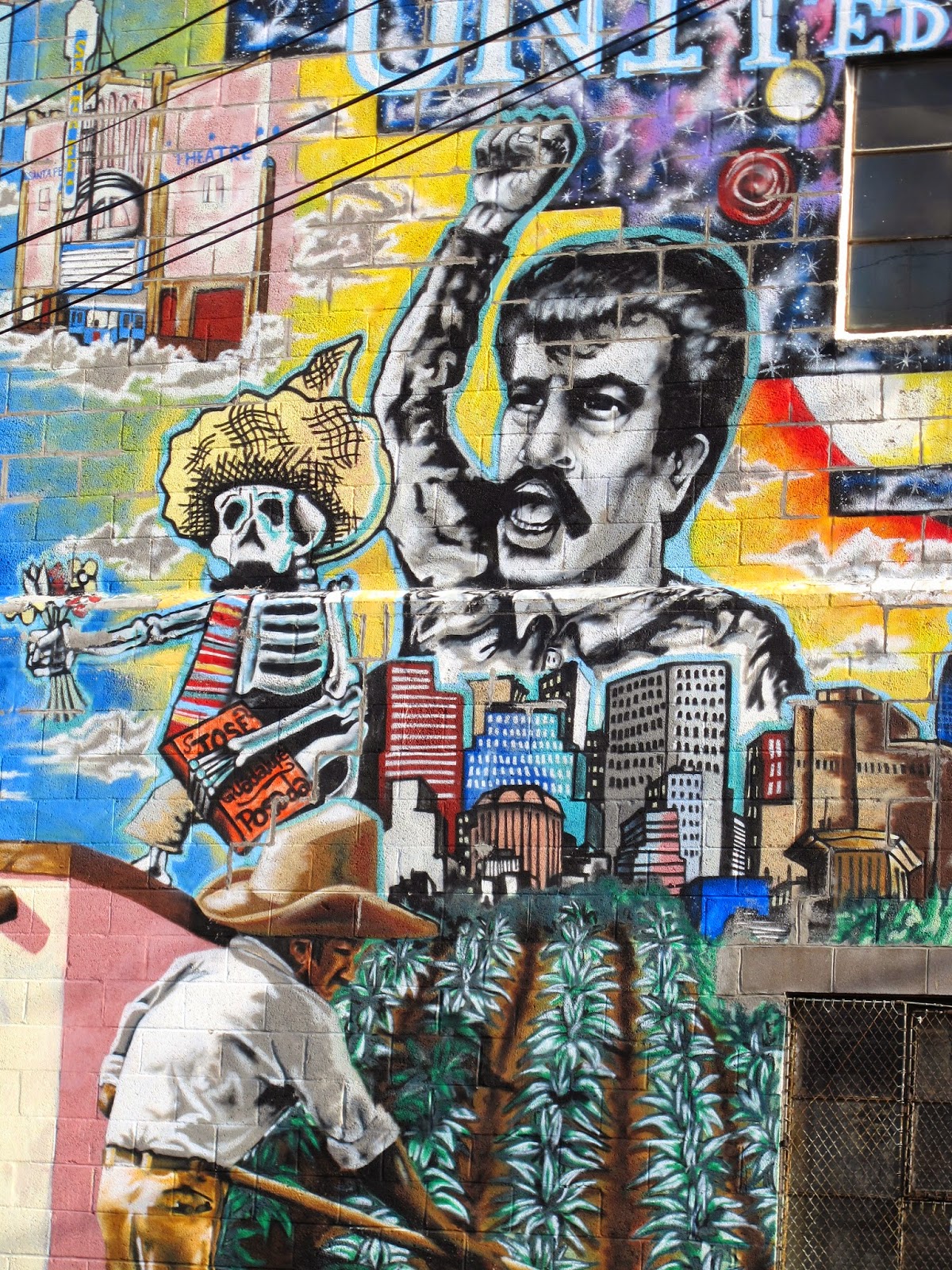
I am constantly surprised and in awe of all the art that is around Denver, especially the murals that I encounter! One fine example is the large mural on the south side of Eight Avenue between Kalamath and Santa Fe. Marc Anthony Martinez spray painted this "History of the Westside Community" in 2002.
The one scene depicts a Mexican workering in the sugar cane fields.
The man with the mustache is Rodolfo "Gorky" Gonzales, an activist who promoted justice and equality for the Mexican- American.
Above and to the left of the farmer is the calavera (skeleton) holding a book by Jose Posada. Posada who was instrumental in the creation of the calavera catrina shown on the left with the fancy hat on. (for more on Posada, see post dated July 21, 2010).
In the lower left corner is a melted clock, inspired by Salvador Dali showing how time flies. Above the clock is a mother hanging up her childrens's sports school uniforms from West High School. The pink structure is the beautiful 1920's St. Cajetan Catholic Church which is now part of the Auroria Campus. The big three-faced sun is symbolic of the Mestizo, one of Indian and Spanish blood.
The red building with the awning is the Buckhorn Exchange Steakhouse, Denver oldest restaurant at 10th and Osage dating back to 1893.
Above the window is the Buyers Denver Library built in 1918 on Santa fe Drive. I have always loved this building.
The big American flag has different colored hands on it portraying the many cultures. The yellow building is Tacos de Mexico which has some of the best breakfast burritos. Next door is El Noa Noa, another Mexican restaurant on Santa Fe.
The Santa Fe Theater.
A panoramic view of Denver's skyline with the large white building (republic Plaza), the Denver Art Musuem and the blue building knick-named the "Cash Register" building.
If you look closely, you will see a Calavera watering skiing!
It's a wonderful mural. Check it out.
The one scene depicts a Mexican workering in the sugar cane fields.
The man with the mustache is Rodolfo "Gorky" Gonzales, an activist who promoted justice and equality for the Mexican- American.
Above and to the left of the farmer is the calavera (skeleton) holding a book by Jose Posada. Posada who was instrumental in the creation of the calavera catrina shown on the left with the fancy hat on. (for more on Posada, see post dated July 21, 2010).
In the lower left corner is a melted clock, inspired by Salvador Dali showing how time flies. Above the clock is a mother hanging up her childrens's sports school uniforms from West High School. The pink structure is the beautiful 1920's St. Cajetan Catholic Church which is now part of the Auroria Campus. The big three-faced sun is symbolic of the Mestizo, one of Indian and Spanish blood.
The red building with the awning is the Buckhorn Exchange Steakhouse, Denver oldest restaurant at 10th and Osage dating back to 1893.
Above the window is the Buyers Denver Library built in 1918 on Santa fe Drive. I have always loved this building.
The big American flag has different colored hands on it portraying the many cultures. The yellow building is Tacos de Mexico which has some of the best breakfast burritos. Next door is El Noa Noa, another Mexican restaurant on Santa Fe.
The Santa Fe Theater.
A panoramic view of Denver's skyline with the large white building (republic Plaza), the Denver Art Musuem and the blue building knick-named the "Cash Register" building.
If you look closely, you will see a Calavera watering skiing!
It's a wonderful mural. Check it out.
Subscribe to:
Posts (Atom)