Showing posts with label Oaxaca. Show all posts

Thursday, April 3, 2025

The photography at the Post Office in Oaxaca is very interesting!


The massive post office just of the zocalo in Oaxaca is extremely interesting.  Grand photos of Oaxacan women, marble floors,

an old flatbed railroad cart, 

old fashion mail slots for the city, all of Mexico, the United States and Europe...  But what is really striking are these large photographs of Oaxacan ladies dressed in their regional attire.  

Not much is known of the photographer except for the name above and the address of the studio in Mexico City.   I would guess these photos were shot around 1930.

There is a dance celebration every July in Oaxaca called The Guelaguetza which represents the eight regions of Oaxaca: Valles Centrales, Sierra Norte, La Cañada, Papaloapam, La Mixteca, La Costa, Sierra Sur and Istmo de Tehuantepec.  The Guelaguetza features traditional costumed dancing and each costume, or traje, and dance usually has a local indigenous historical and cultural meaning.

This lady is representing the Valles Central.  Also known as the Chinas Oaxaqueñas, she is “a working woman", typically found in the city’s markets, of a deep Catholic faith, who honors the Virgin or a particular saint with floral offerings and their dance.

They are also known for their jewelry and their long braids.  They carry a cross that represents their religion. And a small charm holding a portrait which may be of a loved one or the image of a saint or the Virgin de la Soledad, a patron of Oaxaca.


In the Sierra Norte region, the huipils are commonly woven from wool and cotton using back-strap looms.  The costumes of this region are characterized by being more sober in color but very rich in texture, adapting to a cooler climate.

From the  Istmo region, the traditional dress of the Tehuanas was known nationwide to be the symbol of the most independent and proud indigenous women in all of Mexico with their opulent huipils and velvet skirts embroidered with local flowers.  Frida Kahlo adapted this style of dress from her mother who was from this region.  Their hair is a crown of braids, although what stands out most is the silk bun and the flowers.  There is the resplandor, a headdress unique to the women of the Tehuantepec Isthmus which consists of starched white lace and can be worn two different ways.  One is on the top of a woman’s head for festivals and the Guelaguetza and the other, at religious events, where it is positioned so that it frames the face.

After my group and I took in all the photographs, we wandered over to the zocalo and low and behold there were a group of ladies in their traditional dress representing the various regions!

Oaxaca has maintained its artistic identity.  The culture, folk art, contemporary art, murals, native dress, cuisine.  

A traditional Mexican proverb proclaims,

 "What you don't see, the heart can't feel."   How true in Oaxaca!


Thursday, March 20, 2025

Saint Lorenzo, also known as Saint Lawrence


Sangre de Cristo, a small church built on top of an old cemetery in Oaxaca, was consecrated in 1689 and declared as its own parish in 1893.  The plot on which it was built was still being used as a cemetery in Oaxaca until the mid-seventeenth century.  Located along the pedestrian Alcala Street across from the Labastida Park, it features a plain facade with an ornate portal and two small bell towers. 

The interior with its whitewashed walls has minimal accent colors, a single nave with no side isles.
 
But what has always intrigued me was the saint holding a grate that stood in the niche on the south side of the church.   A few saints have always interested me:  Saint Martin de Porros, Saint Francis of Assisi, Saint Pascal, Saint Roche (Roch) and of course, Saint Michael (San Miguel Archangel) but I had no knowledge of Saint Lorenzo, also known as Saint Lawrence.


A Spaniard by birth, Lorenzo was one of the seven deacons of Rome, that is, one of the seven trusted men of the Pope Sixtuus.  His job was of great responsibility, he was in charge of distributing aid to the poor and keeper of the library of sacred books.

In the year 257, Emperor Valerian published a decree of persecution in which he ordered that everyone who declared himself a Christian would be sentenced to death. On August 6, Pope Saint Sixtus was celebrating Holy Mass in a cemetery in Rome when he was arrested and murdered along with four of his deacons by the emperor's police. 
 
Saint Sixtus instructed Lorenzo to collect all the money and other goods that the Church had in Rome and distribute them among the poor. 

Overhearing this, the Roman authorities commanded that Lorenzo collect all the treasures of the Church, because the emperor needs money to pay for a war that is about to begin.

Lorenzo asked for three days to gather all the treasures of the Church, and in those days he invited all the poor, cripples, beggars, orphans, widows, elderly, mutilated, blind and lepers that he helped with his alms. 

The mayor arrived very happy thinking of filling himself with gold and silver and when he saw such a collection of misery and disease he was greatly disgusted, but Lorenzo said, "Why is he disgusted? These are the most appreciated treasures of the church of Christ!"

The mayor was enraged, ordering him to be killed.  He was tortured and eventually placed on a gridiron and roasted!  The mayor said, "Since he has so many desires to be a martyr, I will martyr him horribly."

After a while of burning on the grill, the martyr said to the judge: "I'm already roasted on one side. Now go back to the other side to be completely roasted." The executioner ordered him to be turned over and so he burned himself completely. When he felt that he was already completely roasted he exclaimed: "The meat is ready, you can eat." And with a tranquility that no one had imagined, he prayed for the conversion of Rome and the spread of the religion of Christ throughout the world, and exhaled his last breath. It was August 10, 258.

The Martyrdon of Saint Lawrence
by Rubens
1614

Tuesday, September 3, 2024

A morning at the Denver Botanic Gardens to see the Alebrijes created by the workshop of Jacobo and María Ángeles

 
Amadillo - Insect

Jacobo and María Ángeles are married artists living in San Martín Tilcajete in Oaxaca, Mexico.  It is a taller (workshop) that I have often taken my groups to. 

Created by the workshop of the Ángeles', these brightly colored and intricately painted sculptures adorn the grounds of the Denver Botanic Gardens.  These animals are inspired by the Zapotec calendar, also known as Spirit Guides.  Unlike the animals carved from the native Copal wood in their taller, these are made of fiberglass and painted with acrylics.


Jaguar - Eagle

The flowers were spectacular at the gardens.
 

Coyote ~ Fish

 Nature is so beautiful!  A cobweb among the plants with the morning dew on it. 

Rabbit ~ Deer

The lily ponds are some of my favorite spots at the gardens.

Deer ~ Butterfly

Monkey ~ Lizard

More water lilies.  Such vibrant colors.


Back in Oaxaca, photos taken on one of my tours.  These wooden carved figures are called Alebrijes.  

The first alebrijes originated in Mexico City, originally created by artist Pedro Linares in the 1940's who created Cartoneria or papier-mâché sculptures.   The papier-mâché-to-wood carving adaptation was pioneered by Arrazola native Manuel Jimenez whom I was fortunate to visit with when traveling with my parents years and years ago.  This version of the craft has since spread to several other towns in Oaxaca, most notably San Martín Tilcajete and La Unión Tejalapan, and has become a significant source of income for the area, especially for San Martín.

The carvers allow the shape of the wood dictate the form of the imaginary animals they create.
One needs a steady hand for this delicate work.

To really grasp the talent and creativity that goes into each of these animals, one really should visit one of the many tallers in San Martín Tilcajete, a place where I am taking another group to in March of 2025.

Fiestas are prominent in Oaxaca and an expression of their imagination.  As an Oaxacan saying goes, "We are Catholic by day and Zapotec by night."  How true in their depiction of the alebrijes. 


Wednesday, August 7, 2024

An Oaxacan Adventure in March of 2025


AN  OAXACAN ADVENTURE

For those who have been on my San Miguel de Allende tours, traveled with me to Chiapas, Mexico City and Puebla along on my Artisan and Architecture tour in the state of Michoacan, I know if you join me in March, Oaxaca will also capture your heart.   It certainly has mine.

After leading numerous tours to Oaxaca and spending two relaxing weeks over Christmas with my husband, it was time to fine tune my dining list, try some new places and cross some off my list. I also tweaked my schedule from my last tour to Oaxaca for I have included some new restaurants, a few more stops on the side trips including one to Etla and much more...

The main plaza, the zocalo, is one of the most spectacular in all of Mexico with its gazebo that usually has a marimba band playing in it at night, vibrant cafes and restaurants lining the plaza on the main and second floor, the Cathedral on one side, town's people visiting...  
We will be staying right in the heart of the historic center of Oaxaca City at the colonial Hotel Parador San Miguel, located just two blocks from the zocalo.
One morning we will explore Monte Alban,
 the Zapotec ruins that was founded around 500 B.C..  
 At its grandest, over 25,000 people lived here.
Another morning at Mitla, ruins that date back to 100 A.D. with its distinctive geometric mosaics.
The architecture in the Oaxaca valley is diverse from this brilliant painted church in Ocotlan,
to the 16th century monastery in Cuilapan de Guerro,
to the lavish Baroque Santo Domingo de Guzman Church in the historic center of Oaxaca, 
to the Museum of Oaxacan Culture housed in a magnificent building with incredible views

to the Contemporary Art Museum that is in a beautiful colonial mansion dating back to the late 17th century.
We will visit many villages on their given market day which is a wonderful experience in itself.
One day will be an excursion over to Etla on their market day.  First stop at a ranchito where were we will have a cheese making demonstration along with a tasting, 
then off to the market to take in all the sights before sitting down for a tamale tasting lunch followed by a famous Oaxacan treat, Nieves (flavored ices) for dessert.  
After we will head over to the Centro de Artes de San Agustin Etla.   
Oaxacan artist Francisco Toledo spearheaded the project of converting an abandoned textile mill into an arts center, which was inaugurated in 2006.
We will take in a cooking class one day which includes a shopping tour of the market. 
Oaxacan cuisine is some of the most interesting and colorful in the world.
It is known for its use of Queso Oaxacan (string cheese), chocolates, tlayudas (shown above), empanadas with squash blossoms...
Famous for its numerous and diverse moles.  And its mezcal.  We will visit the city of Oaxaca market, the true spirit and soul of Oaxaca with the indigenous people dressed in their colorful clothing.  A real stimulation of the senses.
Comida at Origen, known for its creative regional-fusion cuisine to
Comida at the fabulous, colorful countryside restaurant, Azucena Zapotec, where everything is made fresh.
And my favorite dish, Azucena Zapoteca.  Squash blossoms stuffed with cheese and vegetables in a egg batter and tomatillo salsa.  Divine!  Besides a gorgeous presentation.
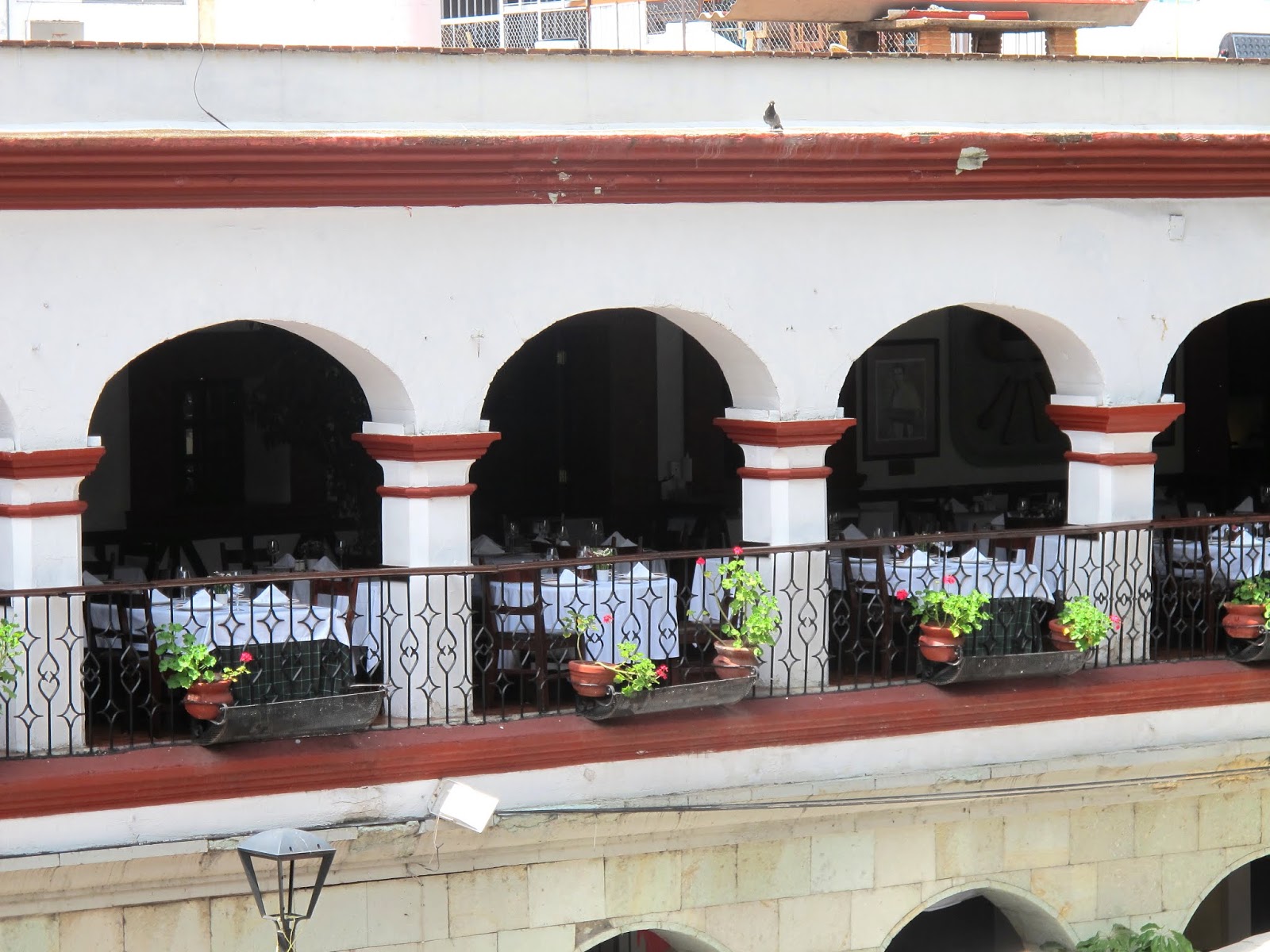
Dinner (cena) at Asador Vasco, a revered old restaurant specializing in Basque and Oaxacan cuisine seated on the second floor balcony overlooking the main square.

Each day we will be a dining extravaganza.
Our farewell dinner in Oaxaca at Casa Oaxaca El Restaurante where we will dine up on the rooftop terrace overlooking the Santo Domingo Church and enjoy the cuisine prepared by Chef Alejandro Ruiz, one of Mexico’s best chefs.
To give you an idea of the over the top cuisine, my entree, 
lamb loin with a pumpkin seed and herb crust, a soft polenta with squash blossoms, sautéed artichoke hearts with garlic butter, spring onions and a port sauce with garlic and rosemary.  So, so delicious!!!
One morning we will have a market tour followed by a cooking class by renowned chef, Pilar Cabrera.

We will visit many of the Oaxacan masters in their villages such as the Aguilar Sisters famous for their ceramic figures, 
  the Mendosa family, ninth generation of weavers, in Teotitlan de Valle where we
will have a special demonstration on how the natural dyes are created before viewing all the family's beautifully hand-woven rugs to 
San Martin known for their hand-carved wood and beautiful painted Alebrijos (animals).
Another stop at the Navarro family famous for the weavings all done on a back-strap loom.
And a visit to San Bartolo de Coyotepec famous for their highly polished black pottery.
There is an abundance of museums:  Rodolfo Morales Museum in Ocotlan.  Rufino Tamayo Museum,  M. Alvarez Bravo Photographic Center,
and the Museum of Textiles in Oaxaca City
and Museum of Contemporary Art with outstanding exhibitions that are constantly changing.  There is even a Stamp Museum that we will visit.  There are cutting edge galleries in the historic center of town.  Lovely climate, friendly people and fabulous restaurants.  Oaxaca has maintained its artistic identity.  The culture, folk art, contemporary art, music, native dress, cuisine....
 
If interested, message me and I will send you a detailed itinerary along with pricing, flight information and deposit request.  I am limiting this to a total of eight and I already have two commitments.

An Oaxacan Adventure 

March 7 - 15, 2025