skip to main |
skip to sidebar
The Kirkland Museum of Fine and Decorative Art just celebrated its one year anniversary in its new location at 1201 Bannock Street in Denver's Golden Triangle district. This 38,500 square foot building was designed by Jim Olson of the Seattle-based architectural firm Olson Kundig. It's a striking building along with the Vance Kirkland studio and art school that was moved from its original site.
The museum fits in beautifuly to the area with the Denver Art Museum, Clifford Stills Museum and Denver Library as its neighbors.
The museum features three distinct collections. The International Decorative Art with more than 4,000 pieces from Arts and Crafts, Art Nouveau, De Stijl, Bauhaus, art Deco, Postmodern and other periods. Colorado and Regional Art, over 7,00 works by 750 artists. And Vance Kirlkand's works (1904 - 1981).
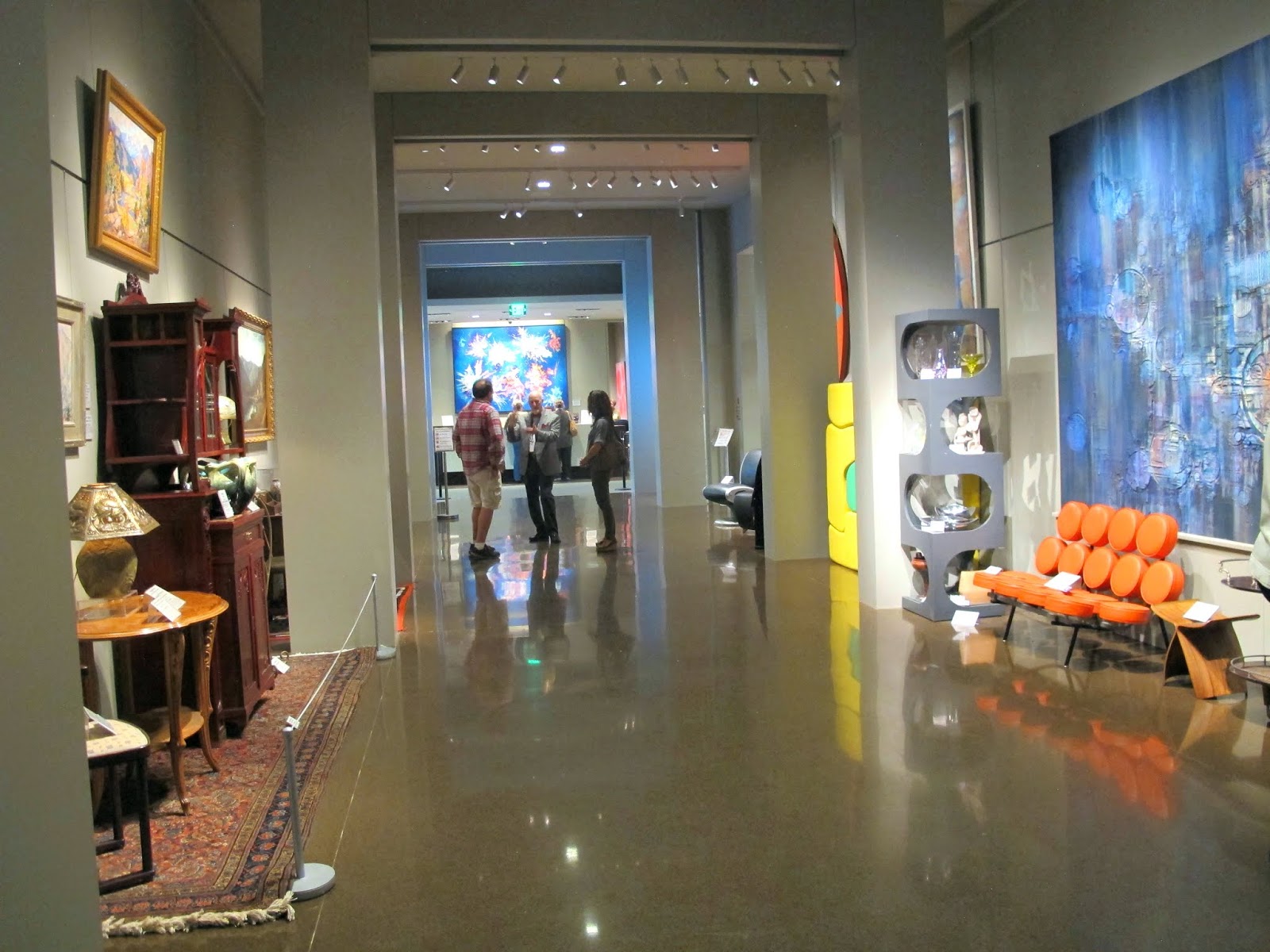
What is unique to the Kirkland Museum, the art is arranged in salon style in which the paintings and sculptures share the same space with other decorative art.
Upon entering the museum, behind the welcome desk is Kirkland's oil and water painting, Concerning Scorpio Ten Billions Years B.C.. (The Dot Paintings - 1977 - 75" x 100")
The visitor lounge has a great display of ceramics that can be seen from both inside and outside the museum.
Above is the Promenade Gallery in which the other galleries branch off from. Such a great view of Kirkland's painting at the end of the corridor. He produced five major periods of paintings: designed realism, surrealism, hard edge abstractions from nature, abstract expressionism and dot paintings.
The Illusion of Floating Mysteries in Red Space - 1975 - 5th peroiod / dot painting - 75" x 139"
The Promenade Gallery.
Looking back to the welcome desk.
At the entrance of the sculpture gallery you will find the cast bronze figures, Orepheus and Eurydice (1960) by Colorado artist Edgar Britton.
Britton taught at the Colorado Springs Fine Arts Center from 1942 - 1950. He also had commissioned pieces for the Denver Botanic Gardens and the Brown Palace Hotel in downtown Denver.
Realism and Arts and Crafts gallery.
The Bauhaus gallery.
The next few pieces of art are some of my favorites. Landscape with Bridges (1923) by Colorado artist, Charles Ramus who taught at the University of Denver School of Arts from 1942 - 1969.
Along the Track (1936) by Colorado artist Kathleen Vavra .
Siesta by the lake (1940) lithograph by Colorado artist, Hayes Lyon (1909 - 1987).
Two Men with a Melon (late 1940's) by William Sanderson (1905 - 1990). Sanderson worked as a graphic illustrator in New York City. He was stationed as Lowry in WWII and after the was taught at the University of Denver.
By the Canal (1929) by Birger Sandzen. Sandzen immigrated to the United States from Sweden in 1894. He painted many summers in Colorado, especially in Estes Park.
Great display of Art Nouveau and Art Deco ceramics.
The Referential Abstraction gallery.
Some of my favorite pottery, Bizarre Ware / Banded Ware, 1930, designed by English artist Clarice Cliff.
I adore the Art Deco demitasse cups and saucers - 1930 - English.
The Modern gallery which I can personally relate to for I grew up in a house full of Bertoia, Eames and Saarinen furniture.
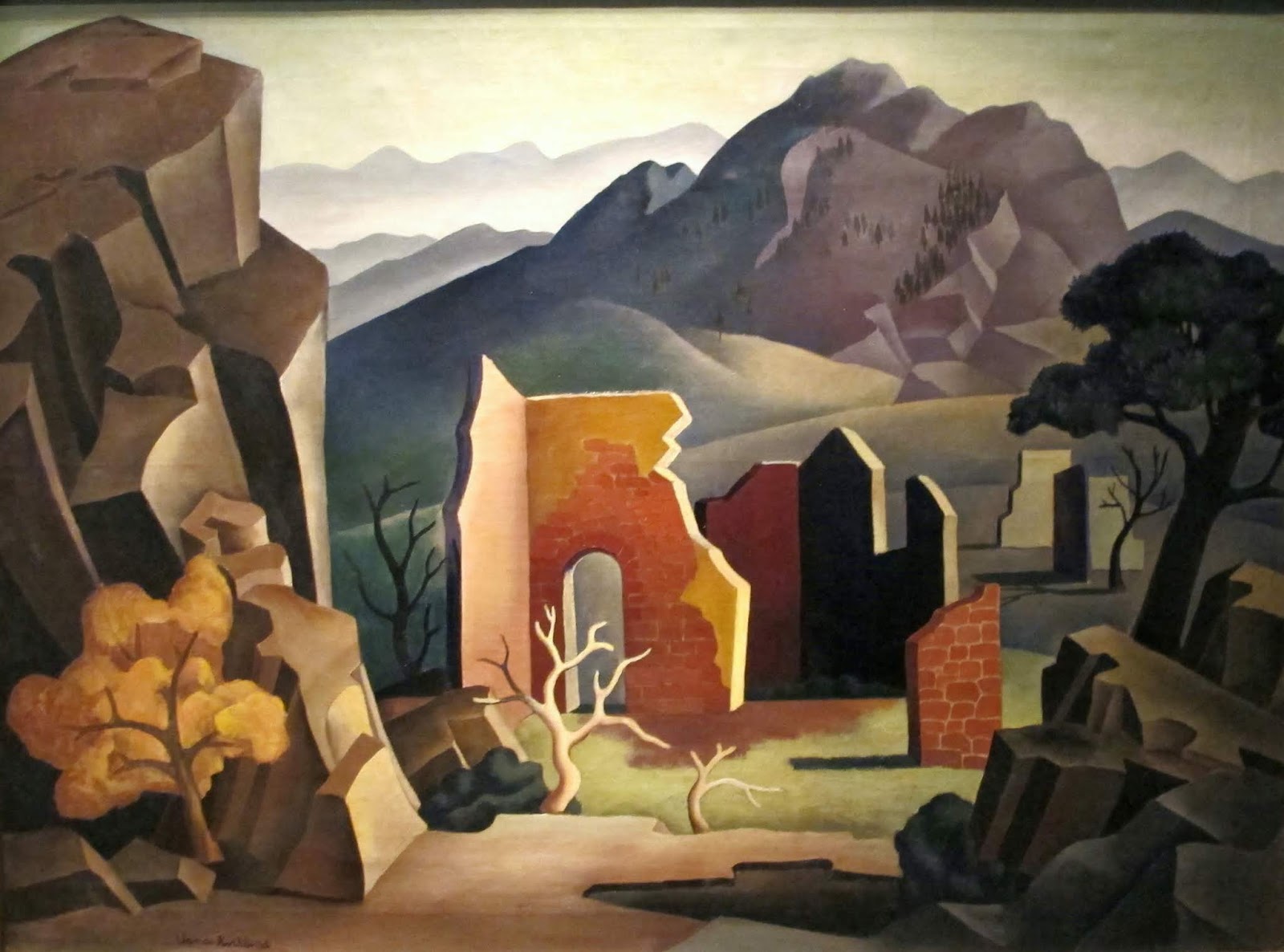
Ruins of Central City (1935)
and Monastery at Ronda, Spain (1931) by Vance Kirkland are two of my favorite pieces of his painted during his 1st period, Designed Realism.
Kirkland's studio. He would suspend himself on the straps above his paintings.
What a great space to work in.
In the back of the museum is the video room where you can sit and watch how the 105 year old original studio was transported to its new location. At 13,840 square feet and an estimated weight of 150 tons, it took over eight hours to move the building eight blocks.
I have been several times to the Kirkland Museum since it relocated to its new site. It is one of my favorite museums!
Kirkland Museum of Fine and Decorative Art
1201 Bannock Street
Denver, Colorado
Tuesday - Saturday: 11am - 5pm
Sunday: 12pm - 5pm
Monday: Closed
Basket weaving is probably Mexico's oldest craft and one that has not changed over the years. Remnants of baskets have been found in Mexican caves dating as far back as 7,000 B.C.. It is believed that basketry developed before agriculture and that the nomadic
hunter-gathers wove containers to collect and store their food and carry their supplies.
A wide variety of baskets can be found in the traditional indigenous Mexican markets, especially in Oaxaca. From utilitarian baskets used for harvest baskets and bread trays to purely decorative. A variety of shapes, colors and weaves.
So many uses for the different shapes above. The small pueblos south-east of Oaxaca City in which baskets are produced are Santa Cruz Papalutia, San Juan Guelavia and Magdalena, way of the beaten track.
In the entrance of the Benito Juarez market in Oaxaca City, there are a few talented women from La Mixteca region weaving and selling the striking palm baskets in brilliant colors. Called tenates, these baskets were originally woven to hold hot tortillas.
The different designs are
influenced by the ancient Zapotec culture. Similar to the patterns found in the stone work at Mitla. These ancient weaving patterns are called petate, the Nahuatl word for bedroll.
The artisans go into the hills to collect the palm leaves which are then dried in the sun for three days. Later they scratch the palm with a knife to remove the cuticle. The palms come in four different types: white, yellow, Ixcate and mountian - each different by its color, size and malleability. A combination of natural and dyed palm fibers are used to create these beautiful baskets.
An average size basket takes 2 to 3 hours to make and each artisan can weave up to three per day. Very
pliable, these lidded containers, round or square, are the ideal
vessels for gifts. Much better than a paper gift bag. I stock up on
them every time I am in Oaxaca. How can you not resist buying a few to take home - they pack well and weigh practically nothing.
Wander deeper into the market and you will find a variety of stalls selling woven bags.
For my Oaxaca tours, I usually buy a variety of these and fill them with candy, a welcome folder and other goodies that await my guests in their rooms.
These baskets woven in a heavy plastic are perfect for your carry on tote when traveling. The are pretty indestructible.
Basket weaving is dependent on the areas local plants such as reeds and grasses, cane and willow twigs, cactus and palm fibers for the raw material.
After taking my group to Monte Alban, we head over to the Thursday market in Zaachila. This is where you will find these beautiful, sturdy baskets with handles. The weavers work with "carrizo", a reed from Antilla brought over during the Spanish times, and bamboo, first introduced in Morelia from Asia.
I could not resist purchasing this one from this charming lady.
A few years ago, I did a flower arranging presentation for the Bow Mar Garden Club just outside of Denver and I used that basket I had purchased in Zaachila. After lining the basket with heavy plastic to ensure it was water tight, it made for the perfect container to showcase the pink peonies, the pale green Viburnum along with the rhubarb leaves that lined the perimeter.
Such creativity.
Across from where I had bought the basket in the Zachilla market was a lady selling these large basket, Tompiates.
These Tompiates are used to transport and store fruits, vegetables and other bulky items.
Friday is the big market day in Ocotlan de Morelos and is one of my all time favorite markets. This large basket has served her well over the years.
How beautiful are these purple-blue Agapanthas standing in this big "canasta".
It's always a busy day on Sunday over in the Mercado de Abasto, Oaxaca City's foremost retail and wholesale market on the south-west edge of the city. Covering a multitude of city blocks, this market sells absolutely everything. There is a specific section solely dedicated to baskets. My good friend Esther from San Miguel de Allende and I were marveling on the size and durability of this one basket.
You rarely see a women without her basket when selling or shopping in the markets.
A vendor unloading her produce from her basket at the market in Tlacolula de Matamoros. You can identify the ladies from this area by the colorful bandanas they wear on their heads.
Such gorgeous produce on display in these baskets. And my favorite, Flor de Calabazas (squash blossoms).
One Friday afternoon, we were heading back into Oaxaca City and we spotted these two ladies and the little boy on their way to a festival that was in front of the church we had just passed.
In the main zocalo near the main Cathedral you will see women with baskets on their heads selling roses and gardenias.
Just one of the many ways baskets are utilized in the Oaxaca valley. And each basket is truly unique!