skip to main |
skip to sidebar
Being April Fool's Day, I thought I would post some funny and amusing photos that I have shot over the years in San Miguel de Allende and a few other towns in Mexico.
In the main square, the jardin, this cute boy was having fun poising as one of the super heroes!
Sweet gal in a butcher shop in Santa Clara de Cobre in the state of Michocan. How appropriate, I took this when the swine flu had just raised it ugly head.
I am fascinated by pig's heads when I see them in the market in Mexico and Spain. Don't ask me why, I just am.
Great tile that I spotted on one of the streets warning you of the dog, Caution!!
Do you think the cat is waiting for lunch?
No translation needed. Great graphic.
Patiently waiting to be let back in from an outing around town.
How more relaxed can one be!
A dogs day afternoon.
I have walked past this door jam so many times. It cracks me up every time.
The cloud could not have been in a better place...
Up at the Tiangis, the Tuesday market. Again, I am fascinated with the piles of chicken feet.
Great selection of bras in the market.
Mannequins laid to rest.
I admire those who can wear such high heals and still walk on all the cobblestone streets. Pretty stylish.
I laughed when I saw this, my electrician would just die.
The phone lines in most of the historic center are under ground. Apparently not in this neighborhood.
Sitting in the front table at La Petit Four having an espresso and one of their yummy pastries, the garbage truck goes by. The question, did someone discard an old mattress or is this for when the garbage men get tired and need a rest...
Too bad there were no people in the SUV to complete the photo.
How fun to leave the church in a decorated VW Thing!
And talk about "pimp my ride". A deer pelt on the one motor cycle's seat. Only in Mexico.
There is always something around the next corner in San Miguel. That is why I love to get out and just walk around town or sit in the jardin and watch the world go by. Never a dull moment.
The green pottery of Aztompa originated in the Oaxacan town of Santa Maria Aztompa and can be found in the markets around and in Oaxaca. This particular photo, I took in one of my favorite markets, Friday morning in Ocotlan de Morelos.
The glazed pottery is usually designed with utilitarian purposes in mind such as cooking and serving and even to hold candle and flowers.
Santa Maria Atzompa has been making pottery since the 7th to 9th century when it acted as the satellite city to its larger neighbor, Monte Alban.
It was after the Spanish conquest that the lead glazing techniques were introduced by cleric Alonso Figueroa and little has changed in the process today, green being the preferred color of choice. About 90% of the people in Santa Maria Atzompa are dedicted to making this pottery, thus contributing to the town's basic economy.
The clay is mined 4 kilometers away in an area called San Lorenzo Cacautepec. The clay is mixed with water to make it uniform. The pieces are made on a foot operated potter's wheel, then set aside to air dry for 8 days before firing. The pieces are fired twice, the glaze is applied just before the second firing.
Sunday morning over in the Abastos market in Oaxaca City.
A busy day on Wednesday at the market in Soledad Etla, you will find grandiose sized green glazed bowls filled with Atole.
Atole Dulce
and Atole Blanco.
Atole is an acquired taste for us gringos from the states. Its an ancient masa (corn) gruel made with water (sometimes milk), with or without sugar. Corn gruel was the basis of the Mesoamerican diet before 500 B.C. and Atole is just thinned corn greul.
Atole is usually made with corn kernels, cooked long enough to grind on a metate. Then more water is added and then cooked until it thickens.
You will find a variety of Atoles often combined with other ingredient in Oaxaca. Sugar is added to some. Add chile and you get Chileatole, a well known cure for a hangover. Atoles are also made with a variety of tropical fruits such as guava. Other flavoring include chocolate, vanilla, juices, nuts, seeds, rice and fresh corn.
The glazed green bowl is a perfect vessel to display Los Gusanitos de Maguey, the Maguey worms. They are dried, smoked larvae of the tiny insect that lives on the Maguey (agave) plants used to produce Mezcal.
When I am leading a tour to the Oaxacan valley, we start one day in Monte Alban followed by a stop to the Thursday market in Zaachila where we dine at La Capilla, an open-aired restaurant with long benches that serves the best Tlayuda, a signature Oaxacan antojito (snacks made of corn dough). Tlayuda
(or clayuda) is a large well-cooked tortilla spread with a black
bean paste,cheese, sliced avocados, shredded lettuce or cabbage,
tomato and decorated with a beautiful slices of radishs and then toasted on a
comal or grill.
Check out the gorgeous green glazed pitcher.
These green glazed pitchers are also perfect for making and serving hot chocolate, another favorite beverage of the area.
Comida (lunch) at one of my favorite restaurants in Oaxaca is Origen. What a gorgeous entree served in this green glazed bowl.
I bet the next time you are in Oaxaca, you can not resist buying a pitcher or bowl or both.
Last time I purchased two bowls with a pigs face with feet that I love to serve my Oaxacan peanuts or guacamole in.
I have been making a lot of soups lately and one of my favorites is my Cream of Roasted Asparagus and Garlic Soup. Roasting the asparagus with the garlic gives the soup an extra dimension and depth.
Ingredients:
4 lbs. fresh asparagus, break woody ends off and discard
5 garlic cloves, minced
olive oil
1 small onion, chopped
3 tablespoons butter
2 cups celery, sliced
1 leek, sliced
6 cups chicken stock
2 cups heavy cream
salt to taste
Toss the asparagus and garlic in olive oil to coat. Place on a parchment lined baking sheet and roast at 350 for about 15 minutes or until tender.
Melt butter and saute the celery, onion and leek until tender.
Once the asparagus has cooled, cut into 1" pieces.
Add to the vegetables.
In batches, puree some of the vegetables along with some chicken stock in a blender.
Return to the pot and add the cream. Salt to taste.
Makes around 14 cups and freezes well.
Bon Appetit!
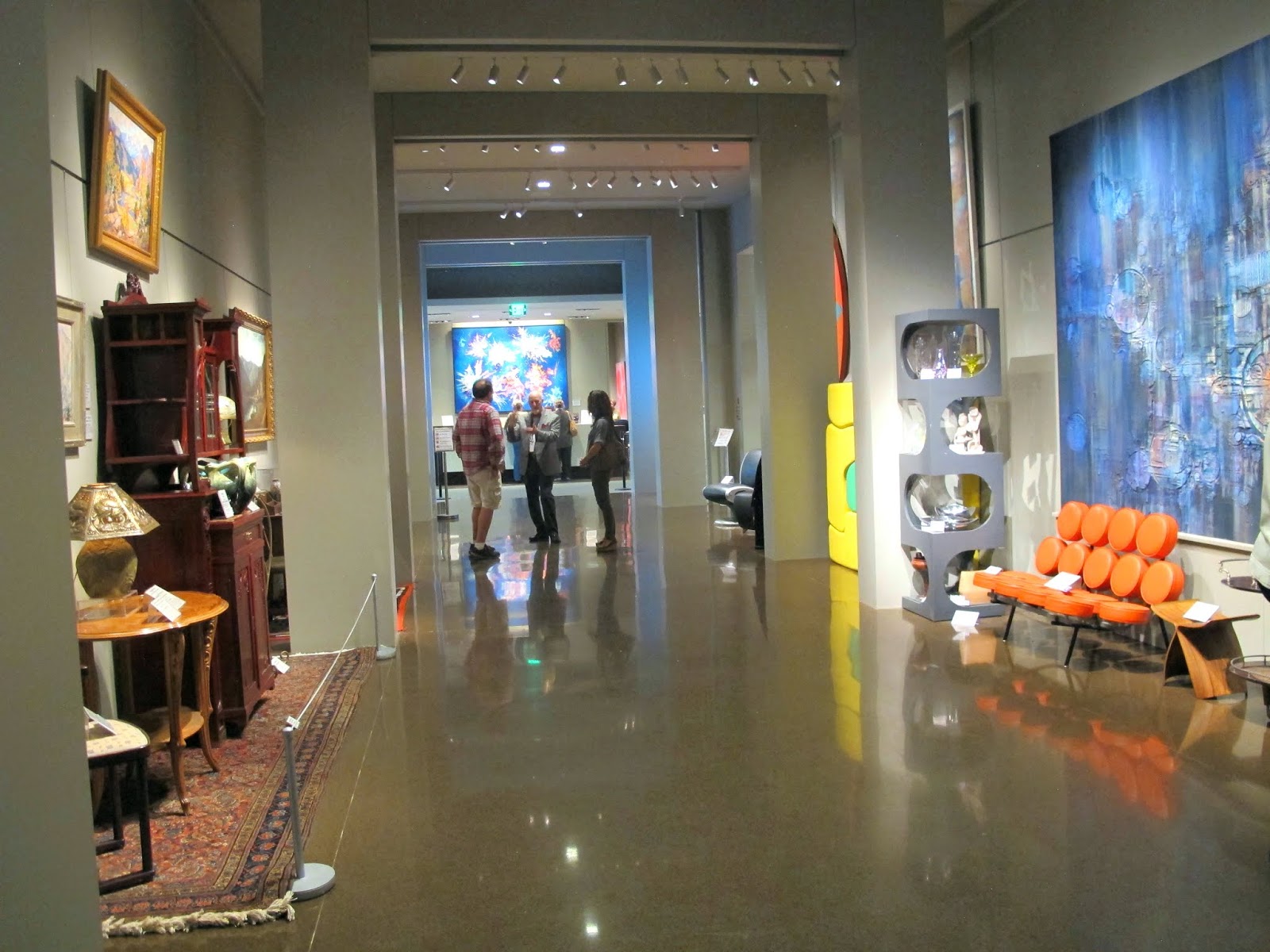
The Kirkland Museum of Fine and Decorative Art just celebrated its one year anniversary in its new location at 1201 Bannock Street in Denver's Golden Triangle district. This 38,500 square foot building was designed by Jim Olson of the Seattle-based architectural firm Olson Kundig. It's a striking building along with the Vance Kirkland studio and art school that was moved from its original site.
The museum fits in beautifuly to the area with the Denver Art Museum, Clifford Stills Museum and Denver Library as its neighbors.
The museum features three distinct collections. The International Decorative Art with more than 4,000 pieces from Arts and Crafts, Art Nouveau, De Stijl, Bauhaus, art Deco, Postmodern and other periods. Colorado and Regional Art, over 7,00 works by 750 artists. And Vance Kirlkand's works (1904 - 1981).
What is unique to the Kirkland Museum, the art is arranged in salon style in which the paintings and sculptures share the same space with other decorative art.
Upon entering the museum, behind the welcome desk is Kirkland's oil and water painting, Concerning Scorpio Ten Billions Years B.C.. (The Dot Paintings - 1977 - 75" x 100")
The visitor lounge has a great display of ceramics that can be seen from both inside and outside the museum.
Above is the Promenade Gallery in which the other galleries branch off from. Such a great view of Kirkland's painting at the end of the corridor. He produced five major periods of paintings: designed realism, surrealism, hard edge abstractions from nature, abstract expressionism and dot paintings.
The Illusion of Floating Mysteries in Red Space - 1975 - 5th peroiod / dot painting - 75" x 139"
The Promenade Gallery.
Looking back to the welcome desk.
At the entrance of the sculpture gallery you will find the cast bronze figures, Orepheus and Eurydice (1960) by Colorado artist Edgar Britton.
Britton taught at the Colorado Springs Fine Arts Center from 1942 - 1950. He also had commissioned pieces for the Denver Botanic Gardens and the Brown Palace Hotel in downtown Denver.
Realism and Arts and Crafts gallery.
The Bauhaus gallery.
The next few pieces of art are some of my favorites. Landscape with Bridges (1923) by Colorado artist, Charles Ramus who taught at the University of Denver School of Arts from 1942 - 1969.
Along the Track (1936) by Colorado artist Kathleen Vavra .
Siesta by the lake (1940) lithograph by Colorado artist, Hayes Lyon (1909 - 1987).
Two Men with a Melon (late 1940's) by William Sanderson (1905 - 1990). Sanderson worked as a graphic illustrator in New York City. He was stationed as Lowry in WWII and after the was taught at the University of Denver.
By the Canal (1929) by Birger Sandzen. Sandzen immigrated to the United States from Sweden in 1894. He painted many summers in Colorado, especially in Estes Park.
Great display of Art Nouveau and Art Deco ceramics.
The Referential Abstraction gallery.
Some of my favorite pottery, Bizarre Ware / Banded Ware, 1930, designed by English artist Clarice Cliff.
I adore the Art Deco demitasse cups and saucers - 1930 - English.
The Modern gallery which I can personally relate to for I grew up in a house full of Bertoia, Eames and Saarinen furniture.
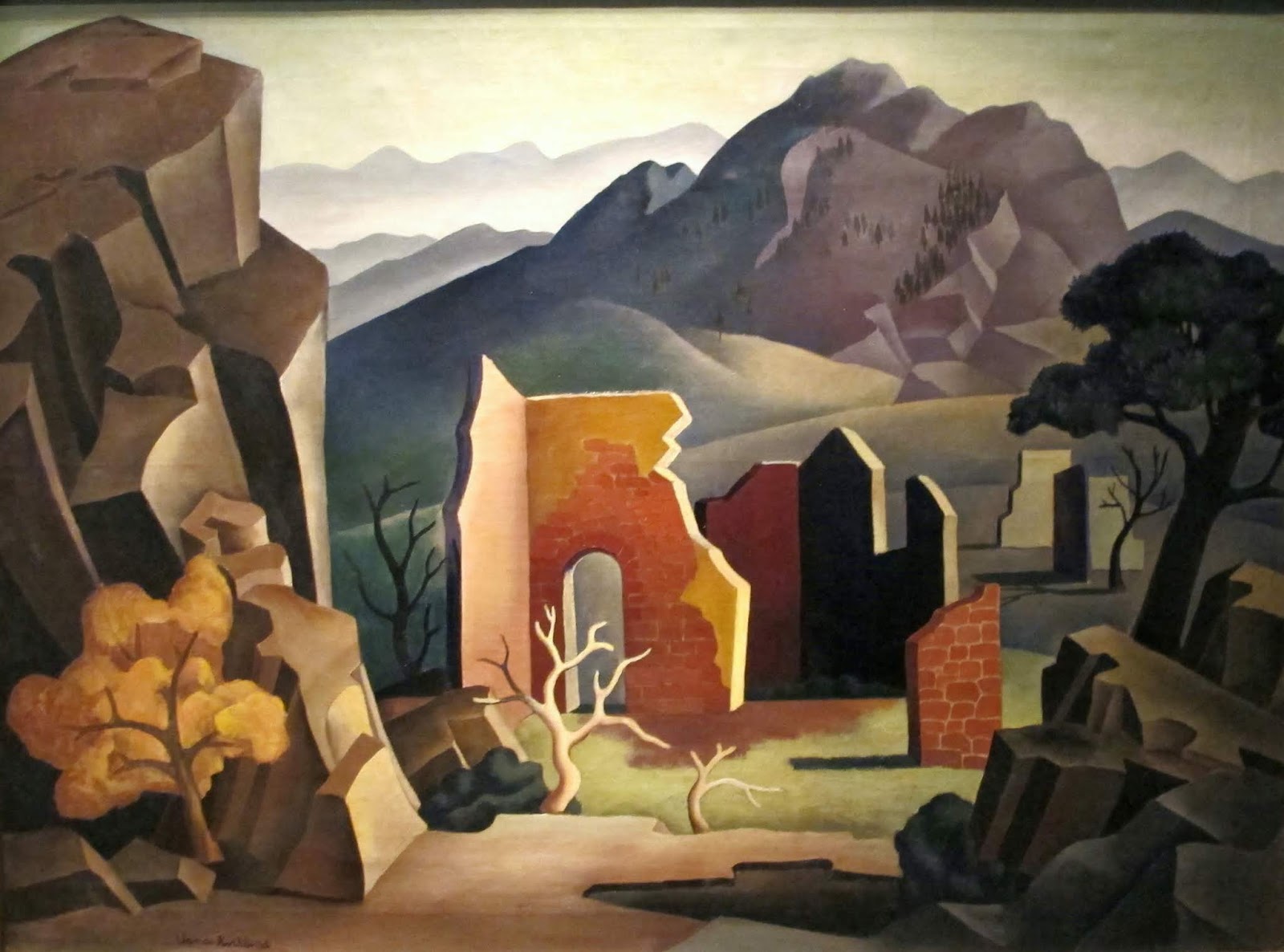
Ruins of Central City (1935)
and Monastery at Ronda, Spain (1931) by Vance Kirkland are two of my favorite pieces of his painted during his 1st period, Designed Realism.
Kirkland's studio. He would suspend himself on the straps above his paintings.
What a great space to work in.
In the back of the museum is the video room where you can sit and watch how the 105 year old original studio was transported to its new location. At 13,840 square feet and an estimated weight of 150 tons, it took over eight hours to move the building eight blocks.
I have been several times to the Kirkland Museum since it relocated to its new site. It is one of my favorite museums!
Kirkland Museum of Fine and Decorative Art
1201 Bannock Street
Denver, Colorado
Tuesday - Saturday: 11am - 5pm
Sunday: 12pm - 5pm
Monday: Closed