Showing posts with label Juan O'Gorman. Show all posts

Tuesday, August 13, 2024

The Library of the National Autonomous University of Mexico (UNAM) in Mexico City


UNAM  -  National Autonomous University of Mexico

Construction of the UNAM Central Library began in 1950 and the library opened its doors in 1956. Designed by the architect and muralist Juan O’Gorman, it’s been classified as a masterpiece of functionalist architecture ever since.
 
The library contains one of the largest book collections in Mexico, with over 600,000 books.  The library needed to be primary windowless to protect this vast collection from the rays of the sun.

The base of the building is made of the volcanic rock on which the building rests and the reliefs there reflect the motifs of the pre-Hispanic cultures of Mexico.  The façades were covered with natural colored stones that shaped the mural titled Historical Representation of the Culture. The mural is one of the largest in the world.

Carlos Lazo (Manager of the Ciudad Universitaria project) was very excited, especially by the idea of making a mural made just out of thousands of colored stones, something that never had been done at that scale.

     “The general theme of the mural is related to the evolution of culture. In the upper part, I represented the cosmological symbols, on the north wall, figures allusive to the pre-Hispanic culture, on the south wall, I developed the argument about colonial culture, on the sides, I referred to the modern age, and on the east side, I represented the atom as a cosmological symbol of our century. I had originally projected the Newtonian concept of universal attraction on the west side. I had to vary it by having to represent there the university shield with the corresponding motto, which, in my opinion, should have gone in the rectory building."   ~   Juan O’Gorman
 
The murals serves as a codex. That’s to say, it’s a narrative of the history of the country and the national university.
 
North Wall: Pre-Hispanic Past
The north wall of the building represents images of pre-Hispanic Mesoamerican cultures and their deities. The theme turns around a life-death duality.  
 
Flowing throughout the entire mural are the chinampas, blue waterways created by the Aztecs.  The national emblem is the image of an eagle holding a snake in its beak perched on top of a cactus. 

 
West Wall: The University and Modern Mexico
 
It's the National University in all its grandeur with the coat-of-arms holding the most central position. Other representations include the studies of science, culture, sports and engineering.
At the very top, we can see a banner flying in the wind with the words the National Autonomous University of Mexico in large letters. Below is one Mexican eagle and one Andean condor holding large shield with a map of Latin Americas with a star where Mexico located.  Around the shield is the phrase, “For my people, the spirit shall speak.”
South Wall: Colonial Past

Depicts the arrival of the Spanish in Mexico and the Conquest, and a dual God and Devil.  It also presents the physical trappings of that period of history, including churches, guns, maps, manuscripts and monks.                                 
 East Wall: Contemporaneous World

Portrays Mexican modernity, with the Revolution as one of its themes. In the center, a model of the atom generates the principle of life.  And the difference of the moon and the sun look down from above.

What a beautiful campus!

The entrance going into the library.
 
It was the perfect afternoon to visit this extraordinary building.


Wednesday, July 24, 2024

ANAHUACALI MUSEO in Mexico City is definately worth a visit!


I recently returned from leading a tour to Puebla and Mexico City and we had the best time.  New to my tour this time was a visit to ANAHUACALI  MUSEO!  Wow!  So spectacular and we were almost the only people there!

Diego Rivera, the famous Mexican muralist, was also an obsessive collector of pre-Hispanic artifacts during his life, and by the time of his death he had amassed over 50,000 ancient objects. Rivera often sought artistic inspiration for his murals from these pieces, and indeed his greatest artwork often portrays scenes from pre-Hispanic history that reveal the reverence and curiosity he felt toward the past. 

For decades, Rivera and his wife, Frida Kahlo, had planned to build a museum where the Mexican public could visit and contemplate their collection.  Rivera saw some sketches by architect Juan O’Gorman and after consulting with the famous American architect Frank Lloyd Wright,  he designed this building himself.  The Anahuacalli construction began in 1942.  Unfortunately, due to other commitments and ill health, Rivera’s dream never came to full fruition during his lifetime. When he died in 1957, his daughter Ruth collaborated with Juan O’Gorman and Dolores Olmedo (along with her generous sponsorship) in order to fulfill the artist’s wishes and complete the project by 1963.

The museum building itself was designed according to Mesoamerican principles of architecture and is meant to symbolize a pyramid with a total of twenty-three rooms distributed over three levels.

Several elements of the exterior are built in the Teotihuacan style, 


while aspects of the interior were inspired by Maya temples and in reference to the Aztec pyramids, using a black volcanic stone common to the valley of Mexico.

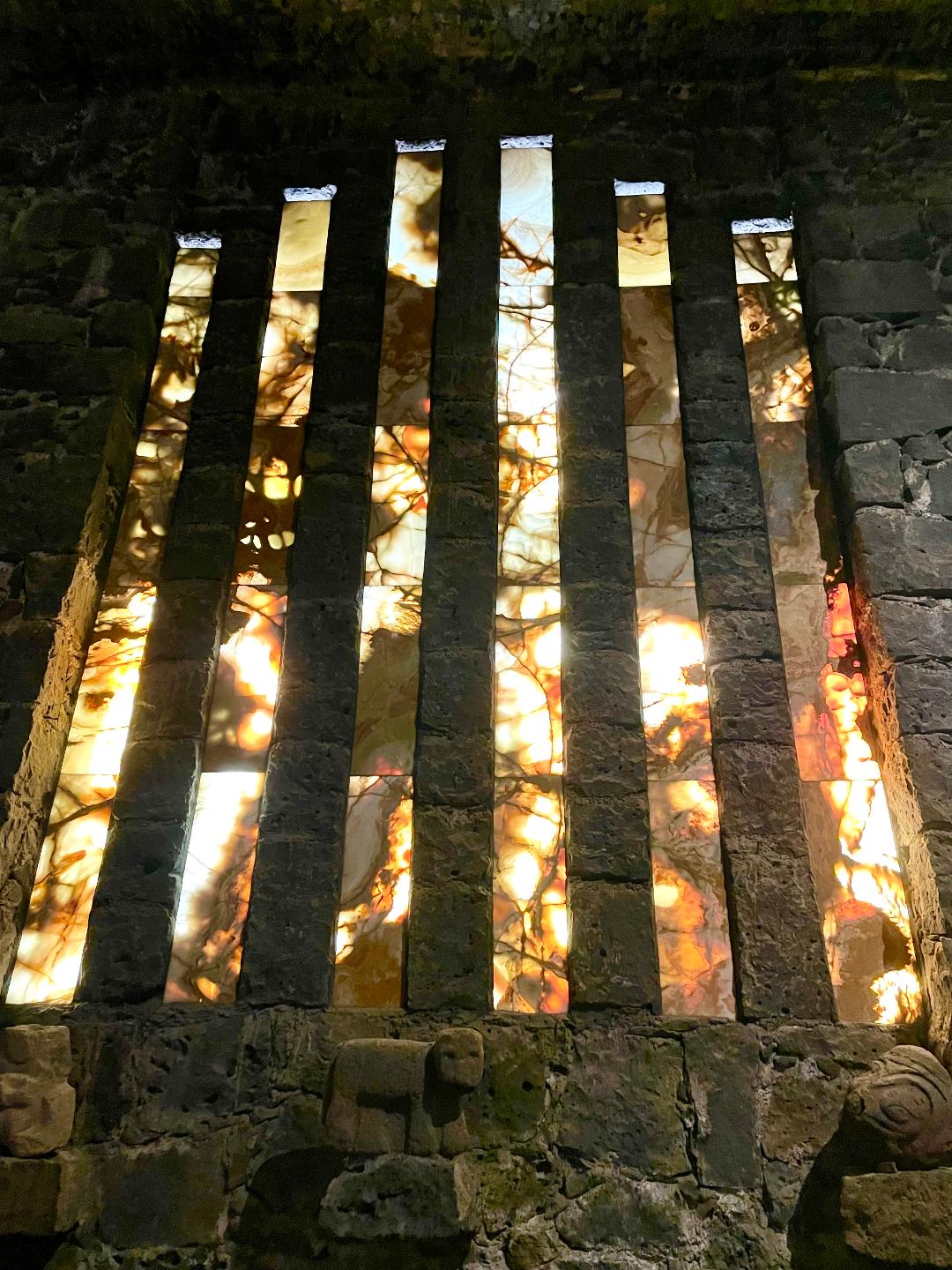
In  the windows, stones were placed in vertical cuts, a tecali stone in thin slabs were used for they were translucent and also complemented the stone.

You will also see many mosaics on the ceilings and walls, based on Rivera’s original designs, that depict the gods and goddesses of the pre-Hispanic cosmos.

A cast mosaic technique was implemented.  Place some cardboard with the drawn sketches directly on a wooden frame.  On these boards, a glue was applied, then the pieces of stone were adhered and finished the mortar.  When dry, the form work and the cardboard were removed.


Though the museum is too-often overlooked, its galleries showcase hundreds of interesting artifacts from all of Mesoamerica’s great civilizations, including the Zapotecs, Mayas, Aztecs, Olmecs, and Toltecs.

The galleries and spaces on the main floor were dimly lit (even thou my camera on my phone took brighter exposures) which made one really feel like you were in the depth of a pyramid.


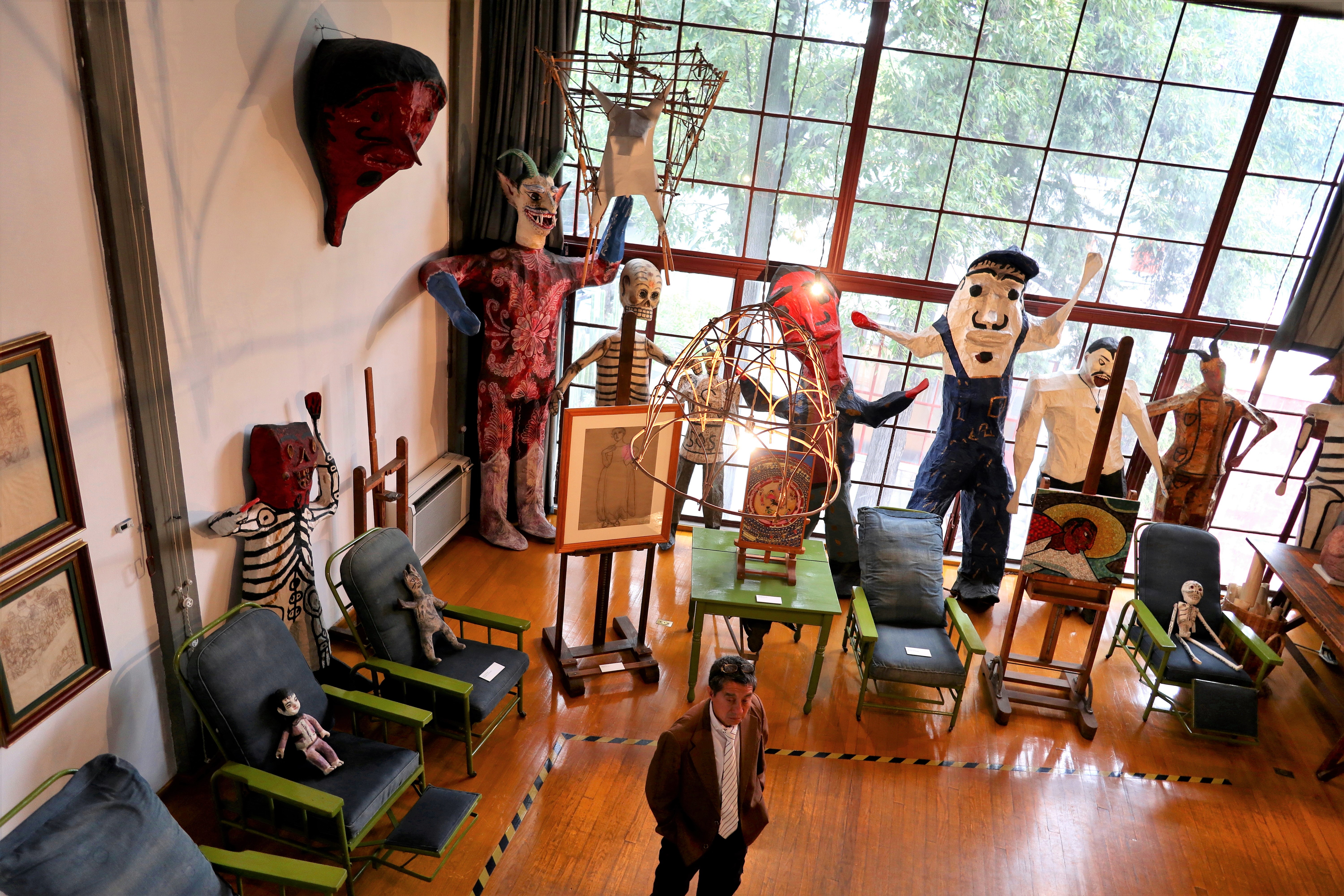
 In the large central space located on the second floor of the Anahuacalli, called the "Study", 16 sketches for different murals made by Rivera in the early thirties are exhibited.

 
Among the sketches stands out the one made for the mural, Man at the Crossroads.  Diego was commissioned to paint a large mural in the lobby of the Rockefeller Center in New York City.  Thru his painting, he expressed views on the evils of capitalism and the positive aspects of socialism.  As work progressed,  he added a portrait of Lenin and other communist ideologies, figures not presented in his preparatory drawings.  When he refused to change the mural, he was paid off and released from his obligation.  In 1934, it was completely destroyed but in that same year, he received a commission to paint the exact mural at the Museo del Palacio de Bellas Atres in Mexico City. 

While the designs of the ground floor ceiling mosaics are monochromatic, the mosaics on the upper sections were made with stones of different colors.

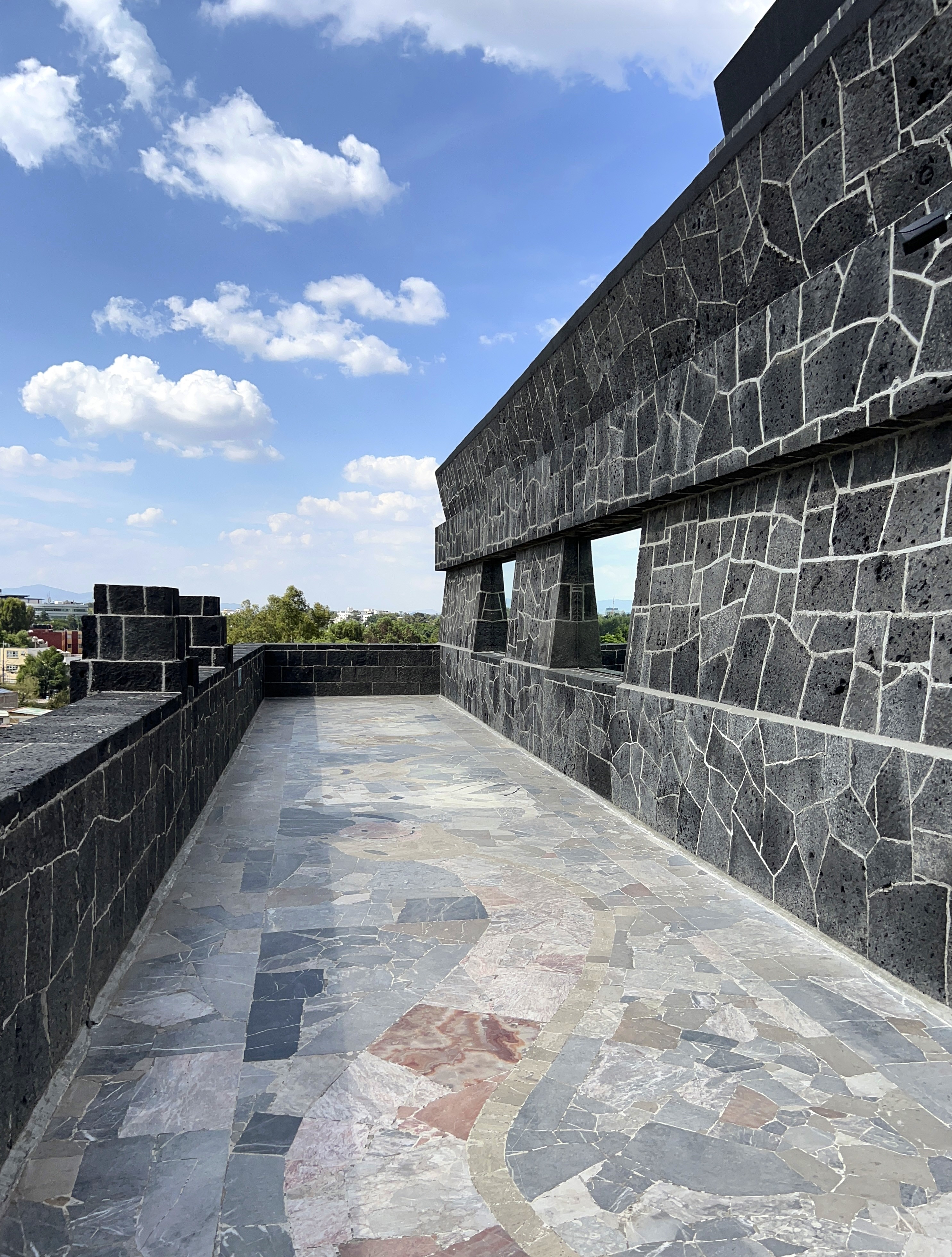
The upper terrace has a breathtaking view.  Not to mention the exquisite stonework.

The total area of land is almost 15 acres, in which Rivera dreamt of a "City of Arts", a space for artistic creation where architecture, painting, dance, music, sculpture, theater, crafts and ecology co-exist.  In the center of the complex is a large central plaza, where various artistic and social events occur.

Located to one side of the main building is the Diego Rivera gallery, a space for high-quality temporary exhibitions.  Another striking building is the Sapo-Rana Art Library, which houses various art books and the collection of 2,400 copies from the personal library of the anthropologist Eulalia Guzman, who donated them to the museum in the 1950's.
Separate buildings laid out in this complex are connected by walkways.  I could totally envision building something like this for individual housing. 


The spaces were just so intimate, inviting and at the same time instilled a sense of spaciousness.  Such creative design!

In memory of Rivera, the following quote was chosen for the inscription engraved on the museum foundation stone: "I return to the people what I was able to rescue from the artistic heritage of their ancestors".

ANAHUACALLI ~ MUSEO DIEGO RIVERA

Calle Museo 150, San Pablo Tepetlapa
  Coyoacán, Ciudad de México

Monday through Sunday

11 am - 6 pm


Friday, July 19, 2024

Juan O'Gorman, architect and muralist

My next two posts on my Blog will soon be on the Library at UNAM, University City and the Anajicalli, Diego Rivera's Museum.  Both located in the southern part of Coyoacán and designed by Juan O'Gorman.  So I thought I would first write a bit about O'Gorman.

He was born in 1905 in Mexico City to an Irish father Cecil Crawford O'Gorman, and Cecil's partner (and distant cousin) Encarnación O'Gorman. Juan O'Gorman's family had long divided their time between Mexico, Ireland, and England, and his father Cecil was a noted painter. His great grandfather had been the first British Consul to Mexico City in 1820.

Despite a cultured and privileged background, Juan O’Gorman’s path was to be a relatively unsteady one, full of reversals of fortune and surprising changes of direction.

Taking the artistic lead from his father, he decided to study architecture at the Academy of San Carlos in the National Autonomous University, where he discovered the work of Corbusier.  At the age of 24, he had built his first house in the well-heeled, traditional neighborhood of San Ángel, for his father.

The house was brutally minimalist, in a style that he would champion for many years, using slab concrete, exposed wiring, and large window divided by smaller panes.  Popular myth says the local response was that O’Gorman’s architecture degree should be revoked. The house is still standing and now available as an Airbnb rental.


Despite the local opinion of his work, his work was popular with his circle of influential friends, including Diego Rivera and Frida Kahlo, for whom he built two individual functionalist houses linked by a bridge. 

These houses are now open to the public and have been preserved as they would have been when the couple lived there in the 1930s.

It was during this decade that a wider interest in O’Gorman’s architectural style peaked and between 1932 and 1934, he worked for the Department of Education in Mexico, building 26 elementary schools under the principles the “engineer-architect” school of thought - maximizing functionality and minimizing cost.

However, despite the success of these schools, O’Gorman became dissatisfied with functionalism and began to move away from it towards organic architecture. He even denounced his previous association with the style, saying it had simply allowed the wealthy to create further profits by cutting building costs.

He began to paint murals influenced by the surrealist-modernist style of Rivera.
 

The most famous of these, Historia de Michoacán (1941-42) in the Gertrudis Bocanegra Library in Patzcuaro, deals with both pre-Columbian history and the colonization of Mexico.  It's a magnificent mural and one I enjoy re-visiting every time I am in Patzcuaro. For more on the amazing mural, see my post dated 5/5/2010.

While living in the area, his second wife, Helen, a sculpture, took an interest in the pottery  of the nearby village, Tzintzuntzan.  At the time, the artisans were turning out crude bowls of soft, low fired clay decorated with painted Picasso type faces.  She suggested they make plates, platters, cups and other pieces that would attract buyers.  As a result, it was a big success locally and abroad.  For years, the artisans would send her samples of their new designs as an expression of their gratitude.  

Many of his murals were socialist and anti-fascist, which led to his murals in Mexico City’s first airport being removed in 1939 just two years after they had been completed.

At the end of the 1940s, Juan returned to architecture, building a house around a natural cave formation in Pedregal, covering it in mosaics which mixed Christian and Aztec symbolism - this was part of his and Diego Rivera’s project to create a vernacular Mexican architecture.  Juan’s reputation as an eccentric character, paired with the fantastical nature of the house, brought busloads of tourists to his door.

For decades, Diego Rivera and his wife, Frida Kahlo, had planned to build a museum where the public could visit and contemplate their massive pre-Columbian collection. Unfortunately, Rivera’s dream never came to full fruition during his lifetime. When he died in 1957, his daughter Ruth collaborated with O’Gorman in order to fulfill the artist’s wishes.  The Anahuacali Museo was built out of volcanic rock and was designed to symbolize a pyramid.


His most lasting creation was the Library of the National Autonomous University of Mexico, which he designed and built in the early 1950s and which has been given UNESCO World Heritage status. The surface is mosaics,  millions of stones chosen by him for their individual colors, and sourced from various regions of Mexico.

Despite his success, the Library soon began to look like the swan song of a man whose demeanor and health started to decline.  In 1969, he sold his house to an architect who destroyed the mosaics and then demolished the house.  Distancing himself from friends and family, his relationship with his second wife Helen broke down.  

In 1982, after being diagnosed with a fatal heart condition, he took his own life.