Thursday, October 27, 2016

What a Party!

 A Party of Mobilization Day
1936 

Coming up on La Dia de Muertos, I thought I would share this wild painting with you.

Last time I was at the National Gallery d' Art de Catalunya in Barcelona, I was particularly drawn to this painting by Daniel Sabater Salabert -  (1888 - 1951).  He painted this during the Spainish Civil War.

Daniel Sabater Salabert was born in Valencia Spain on December 13, 1888.  Before heading to Madrid, he worked in a fan designer's studio.  In Madrid he was exposed to the work of Spanish masters such as Velazquez, Goya and Ribera. 

Below are some examples of his paintings.

 "En Repose"- 1942


 "La Novia de Juan" is simply just wonderful.

He painted military themes in his early career.  In 1912 he moved to Paris for a year where he was commissioned to paint religious compositions for the convent church of St. Vincent-de-Paul, which he executed in vibrant and luminous colors.

"Amor de Santa Teresa" - 1942

He returned to Spain and his canvases featured macabre scenes filled with witches and monsters.  This being his favorite subject, he became known as the "painter of witches." His color palette darkened and took on a sickly blue-green tinge.


One can definitely see the influences of Goya in this painting.

After having an expose in Barcelona in 1920 and troubled with family problems, he traveled to the Americas where he had several exhibitions along the way for the next three years.
 
Sabater exhibited his work at the Sociedad Nacional de Bellas Artes in Madrid in 1910 and also exhibited in Uruguay and Brazil. 

Today many of his works can be found in the Museum of Fine Arts in Valencia.


I will be leading a group to Northern Spain next September and while in Barcelona, a morning at the National Gallery d' Art de Catalunya is on the schedule followed by lunch in the museum's elegant Restaurant, Oleum, with its breathtaking panoramic views of the city.

Please email me if you are interested in joining me.  I am limiting it to a small group and I already have more than half the group filled.

robindsg@aol.com

Jewels of Northern Spain
September 11 - 24, 2017  


Wednesday, October 26, 2016

The patterns and textures of Oaxaca


I just recently got back from leading a tour in Oaxaca with a wonderful group of people.  It was a full week exploring Oaxaca City and the surrounding areas, meeting the artisans, visiting the old ruins and the city's museums, dining at exceptional restaurants...
Every time I am in Oaxaca, I am constantly amazed by all the different patterns and textures in the Oaxacan architecture, design and textiles, all influenced by the ancient Zapotec culture.   This handsome brick pattern at the Textile Museum is a contemporary take on the stone work at Mitla. 
 Mitla, a Zapotec city built in 800 A.D, is a treasure trove of ancient geometric designs.
These designs are actually mosaics, stones that have been cut and been pieced together to create these intricate designs and patterns.
And these hand-woven rugs from Teotitlan de Valle emphasize the design motifs of ancient Mexico, a combination of influences from the Olmec, Zapotec, Mixtec, Aztec and Spanish heritage.
Beautifully woven belts and table runner using similar designs by the Nevarro Gomez family in Santo Tomas Jalieza.  A family that I always look forward to visiting.
A close up of this finely woven belt in the works.
More ancient motifs are incorporated into the painted designs on this alebrije, a hand-carved wooden animal.
A close up of a woven huipil, a women's dress.  
A huipil at the Belber Jimenez Museum that is home to an exquisite collection of traditional Oaxacan clothing. 
Even the signage for the Museo Belber Jimenez is beautifully executed with the geometric design incorporating the M, B and J. 
The current exposition at the Textile Museum showcases several pieces of clothing with feathers incorporated into the design.  Note the geometric designs similar to those found at Mitla. 
Of course I have to include some of the great old, adobe walls that have such tremendous texture and patinas.  This is the facade of the church right in Zaachila where we go to their Thursday market which is one of my all time favorites.
An old ruin right in the middle of historic Oaxaca City.
A special place to dine al fresco after leaving Ocotlan is La Azucena Zapotec.  Not only is the food delicious, the decor is so colorful.  Notice the frame around the window looking into the kitchen.
It is a combination of black cut out tiles from the town of San Bartola de Coyotepec with the scrubbing brushes used in the kitchen and the small hand-painted gourdes used for tasting Mezcal.
The pattern of the wrought iron has an art deco feeling to it but still influenced by the Zapotec designs.
I have inherited my mom's passion for the beautiful craftsmanship in their basketry, especially the ones found in the Oaxaca valley.   These cylindrical designs and motifs can be found everywhere, especially in these palm frond baskets.
The herringbone stonework with its green, grass mortar is spectacular.  This is the courtyard of the San Pablo Academic and Cultural Center, originally the site of Oaxaca's first Dominican monastery. 
This distinctive black pottery is from the town of San Bartolo Coyotepec.  The pottery was made popular by Dona Rosa Real who mastered the ancient art and developed the shiny, burnished effect. 
The pattern on this wrought iron gate leading into the courtyard of the San Pablo Academic and Cultural Center is so unique. 
An accent wall in the courtyard of the MUFI, Museo de Filatelia de oaxaca (Museum of Philatelic and Numismatic arts).  This is the only museum of it kind in Latin America.
The Ethnobotanical Gardens certainly maintains the ancient Mexico motif in the manner in which the plants are planted to
the stonework that is in rectangular plots that act as the filtration system for the run off of rain water as it pours through the downspouts (canales).
An then there is the simple fauna motif used as a border in the San Jeronimo Church in Tlacochahuaya.
Each visit I discover new designs using the ancient motifs.  I might be leading another tour next year in November.  Let me know if you are interested.  It's a great place to get lost in the culture for a week.

Friday, September 23, 2016

The Mexican Cook Book from the 1970's , written and photographed by George and Inger Wallace is a real gem

I bought this cookbook when I was in college right when it was published in 1971.  The recipes are straight forward,  somewhat elementary.  The authors traveled throughout Mexico and put together a collection of their favorite Mexican recipes and adapted them for the American kitchen.  Things have changed drastically in what ingredients one can find now verses back then.  But the thing I like best about this small cookbook is the photography.
First let me tell you a little about the George Wallace...  Born in San Francisco, he excelled in two completely different fields, speed skating and photography.  
He was the only American athlete to compete independently in the 1940 World Games (later known at the Olympics).  He won top medals in Latvia, competing in minus 40 degrees Celsius weather!
In 1939 he was invited by the Oslo Skating Club to train on their outdoor rink and that is where he met his future wife, Inger Dalhberg.  Fleeing Norway after the German occupation, they were fortunate to get the last available passage on the U.S. Manhattan.
Back in the states, he worked for his family's company, US Pipe Mfg..  
He was passionate about photography since the age of 12.  In the late 1940's, he was a full time student on a scholarship for two years under Ansel Adams, Minor White and Edward Weston.   He later became a professor of photography and created a simple hand calculator   to determine the best DOF, depth of field.  He had a knack for shooting from the hip which was useful when shooting in Mexico where the people were standoffish of having their photo taken for they believed the photograph would steal their spirit.  He would engage his subjects in friendly conversation which led to mutual respect which show in the images below.  You can see this in his photos, for many of his subjects have a smile on their face and a twinkle in their eyes. 
He shot with minimal equipment using natural light and sometimes a mini-tripod.
He invented the ExpoDisc.  This disc, like a lens, sets the white balance on the camera enabling the photographer to capture accurate color when clicking the shutter.  Good color and exposure saved the photographer tremendous time from having to make adjustments on the camera's settings and less time in the dark room.  
Most of his photographic archives were destroyed by a fire in 1989, but negatives and slides from Mexico and Norway were spared.
Enjoy some of the photographs below that I scanned from the cookbook along with the copy that accompanied the photo.
"This is one of the three large bands of musicians in Teotitlan del Valle, a Zapotec village in the state of Oaxaca.  These bands provide all the music for the local religious festivals and pageants."   Teotitlan del Valle is one of the villages that I take my group to and is renown for it weaving of rebozas and rugs.
"Their work in the fields caught up and the rainy season begun, mestizos from San Juan Chilateca wait for a ride to the nearby fiesta where they will earn extra money as professional musicians."
"Many men of nearby Santa Catarina Minas share work provided by stills hidden in remote barrancas of this desolate region.  From these stills comes the best mescal in all Mexico."
"Largest of all Indian markets of Mexico, the Oaxaca market is within a day's travel of every conceivable combination of soil, climate and topography, and therefore features an exotic and great variety of fruits and vegetables throughout the year."  And to this day, the market has not changed that much.
"Indians and mestizos alike converge on the large market on Saturdays.  They come from lonely huts in the hills and nearby villages to buy, sell and barter; and to enjoy the excitement of the market place."  The women today still wear their shiny black hair in a handsome braid and always wearing an apron and a reboza as they effortlessly balance their basket full of vegetables on their head. 
"These girls from San Felipe, A Zapotec village on the outskirts of Oaxaca, have just finished a part of their day's work.  Up long before dawn, they ground corn, made tortillas, ran barefoot to market with their wares loaded in baskets and sold hot, fresh tortillas to waiting customers."  I love these baskets and I buy one or two every time I am in Oaxaca. They are beautifully crafted.  Being pliable, I put one basket inside the other , pack my clothes in them and put the the baskets in my big duffle-shaped suitcase.  Back home, I use them for cloths hampers and waste baskets.
"On their way home from Mass, these women and children had been waiting in a small store for a momentary downpour to pass."  I have been there!  Some of the whiteout downpours in the state of Michoacan are unbelievable. 
"With methods as old as the Conquest itself, the women of Teotitlan de Valle spin yarn for woolen serapes for which their village is so famous."  A practice still done the in the old tradition.  And I have purchased the most beautifully woven serape that Ralph Lauren would have loved to showcase in his store.
"This vanilla bean farmer in Papantla, on the hot and humid Gulf Coast, prefers traditional Totonac dress for himself, but indulges in factory-made clothes for his children."
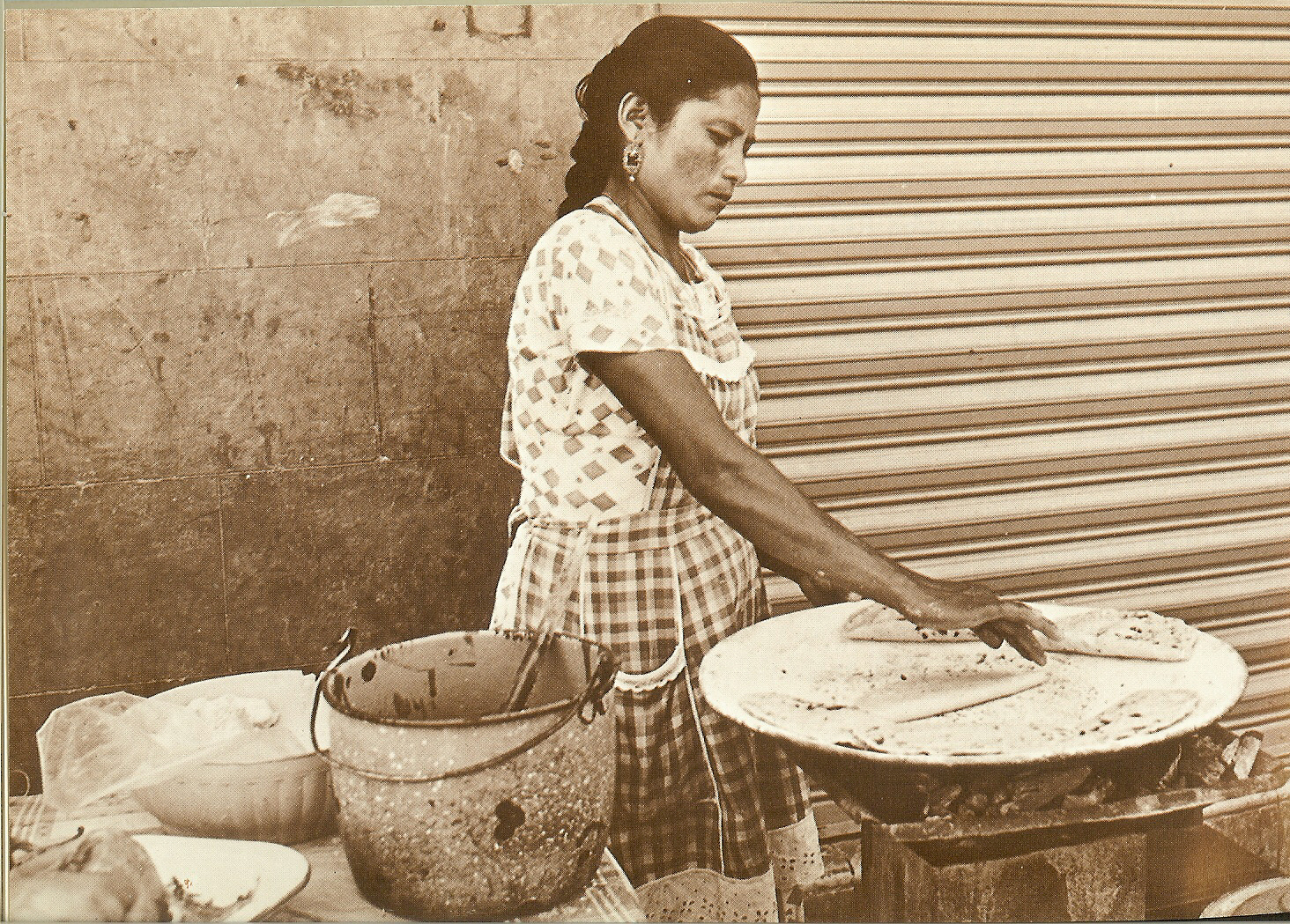
"This mestiza woman is one of many independent small businesswomen preparing and selling antojitos in the streets surrounding the huge Oaxaca market.   A scene very typical of today with the large clay comal used to cook the tortillas and the enamel pot probably filled with a salsa, freshly chopped nopales (cactus pads) or a mole...
"Refugio Masqueda Mercedes Chaves makes charcoal from the hardwood he gathers in the hills above Guanajuato, then hauls it down by burro to sell in the towns.  His strongly Spanish features are evidence of the harshness of the occupation that followed the Conquest of Mexico."  Don't you just love his name?  There were countless times when there would be a knock at our home in San Miguel de Allende with a man with similar looks and his burro loaded with firewood or bags of dirt for the garden.
"The timorous Tarahumaras only slip down from their primitive caves and huts to attend Mass, watch a Baptism or an occasional marriage ceremony, or seek medicine our counsel from the padre on his monthly visit.  He is the only outside they trust."  
Their way of life has not changes since the 1970's.  My next tour may involve taking the scenic train trip through the Copper Canyon where these interesting people live.  The Copper Canyon makes the Grand Canyon in Arizona look small in comparison.  


The Wallace's captured the warmth and spirit of the Mexican people and that is something I have experienced every time I have ventured out to explore some small village in the remote areas of Mexico.  Such gracious, friendly people.

The Mexican Cook Book is still available and I know you can find it on Amazon.  It's beautifully written, the recipes are easy and the photography is spectacular.

Friday, September 9, 2016

Women of Abstract Expressionism at the Denver Art Museum


Abstract Expressionism emphasis is on a large composition with loose brush strokes of color and a grand sense of scale.  The Women of Abstract Expressionism exhibition showcases over fifty paintings by twelve phenomenal artists who worked within the late 1940's and 1950's art world.  These paintings show their personal responses to life experiences.
The entrance to the exhibition is beautifully presented.  There is a striking photo of each artist along with a section of each artist's work.  Mary Abbott, Jay DeFeo, Elaine de Kooning...
Perle Fine, Helen Frankenthaler, Sonia Gechtoff, Judith Godwin,
Grace Hartigan, Lee Krasner,
Joan Michell, Deborah Remington and Ethel Schwabacher.
Looking back on the artists, you see sections of their various works.
Cornucopia - 1958 - Lee Krasner
Kranser was inspired by nature in her depiction of Cornucopia.  As the wife of Jackson Pollock she once wrote, "I'm always going to be Mrs. Jackson Pollock - that's a matter of fact - (but) I painted before Pollock, during Pollock, after Pollock."
Antigone 1 - 1958 - Ethel Schwabacher
Schwabacher painted with a strong palette of colors, with emotion in which she was inspired by the Greek tragedy of Antigone.
Children of Frejus - 1959 - Sonia Gechtoff
This was Gechtoff's passionate reaction upon reading about the drowning of hundreds of children in France when a dam overflowed. 
Her work was inspired by personal and current events.  She said her process was "a combination of emotional reactions to just being alive."  Having success in the Bay area of San Francisco, she moved to New York City in the 1950's but was amazed to find that women artist did not hold the same respect and attention as men.
Untitled - 1951 - Helen Frankenthaler
I like the this piece for the bold brush strokes and vibrant colors.  There is something chaotic about this painting but organized at the same time.  Later on she created a method of stain painting, she would dilute paint to create radiant washes of color on un-primed canvases.  And then pour paint across the large canvas, many times laying on the floor to accomplish this.  She wrote, "A really good picture looks as if it's happened at once... I think very often it takes ten over-labored efforts to produce one really beautiful wrist motion that is synchronized with your head and heart, and you have it."
Western Dream - Helen Frankenthaler - 1957
This was completed 5 years after developing  her  stain painting technique. 
It truly evokes the wide-open landscape of the south-west.  I love the subtle effect she created, to me it looks like it was painted on silk.
Imrie -  Oil paint and crayon on canvas - 1953 - Mary Abbott
Living in the Hampton's, she was inspired by colors found in nature and the U.S. Virgin Islands and Haiti where she spent many winters.
Bullfight - 1959 - Elaine de Kooning
This bold statement of color, movement and energy came from her first encounter of a bullfight in Mexico.  It certainly spells Mexico in my book.
Bill at St. Mark's - Elaine de Kooning - 1956
A portrait of her famous husband, abstract expressionism painter Willem de Kooning.  Avoiding details, she captured his being and demeanor brilliantly in the above painting. 
For a brief period of time, she taught in New Mexico and that experience influenced her work from then on by the color, lighting and expansive horizons of the southwest.  I agree.  The lighting in Santa Fe, just like San Miguel de Allende in Mexico is a painters or photographers ideal place.  It is for me.
Abstraction - Elaine de Kooning - 1947
An earlier work, the bold colors are prevalent but is not as loose of a composition as her later paintings.  I really like her work aall periods of her work.
The Seasons - Lee Krasner - 1957
A completely different approach in depicting nature and the female.
Woman - Judith Godwin - 1954
A very large piece, about 20 feet in length. It's a happy painting.  Her works were inspired by nature, movement and architecture.
Stretched Yellow - Lee Krasner - 1955
Just coming off an exhibition that had not produced many sales, Krasner created a series of collages by applying large pieces of canvas from her older paintings onto the new canvases.  I like this technique and boldness of the composition.  This painting reminds me of Clifford Stills works where he has large void areas in his paintings of just raw canvas as where Krasner uses black.  She said, "This act of destroying in order to create was a form of clarification... and growth."
Hudson River Day Line - Joan Mitchell - 1955.
 She spent the last part of the 1950's living in Paris but she maintained ties to New York.  She describes her paintings as being like poems and an approach that is quite controlled.
Interior: "The Creek" - Grace Hartingan - 1957
The painting is an obscure reaction to the furniture and setting of artist and collector Alfonso Ossorio's East Hampton estate with its intense colors and bold brushstrokes.
Image of Winter - Perle Fine - 1958
When I look at Fine's painting, I feel winter.  She also was one of the few who pioneered the use of collage in her paintings to create movement and depth on the canvas.  Nature, the cosmos, music and dance were her sources of inspiration.
Untitled - Deborah Remington - 1953.
A lot of energy and vibrant colors in this painting.  Clyfford Still taught Remington at the California School of Fine Arts.

It must have been exciting times for these women at a time where is was hard to break into the art world and opportunities were very limited.   I truly loved this show, how it was displayed, especially the signage at the entry and the biographies of each artist with black and white photos of the artist, a brief history on the artist and various quotes from the artist. I choice to highlight the paintings I particularly liked. 

Denver Art Museum
The show runs through September 25, 2016.