Showing posts with label photography. Show all posts

Wednesday, December 30, 2020

The Photography at the Mexican Modernism Exhibition at the Denver Art Museum

The photography at the Mexican Modernism Exhibition at the Denver Art Museum is spectacular.  My personal favorite is the portrait below of Frida Kahlo taken by Edward Weston.  Note, by clicking on any of the images, you will be able to view it full screen.

Frida Kahlo - Edward Weston - 1930

Weston and his Hollywood actress and political activist, Tina Modotti, lived in Mexico City from 1923 to 1927 where they opened a portrait studio. This is where they met Diego Rivera.  It was when Weston was living in Carmel, he headed north to San Francisco to see Diego and meet his new wife.  He was intrigued and mesmerized by Frida.  Above Frida is wearing an indigenous dress, a European silk shawl, three strands of Aztec jade beads and intricate dangling earrings

Weston's style shifted to a more direct, sharply focused and structured photographic style known as “straight” photography, which was championed by Alfred Stieglitz.  He was well known for shooting images of nature, close-ups of vegetables and people’s faces.

Large Ladder - Manuel Alvarez Bravo - 1932

Bravo was born in Mexico City in 1902.   He was a photographer most famous for his poetic images of Mexican people and places.  

He was heavily involved with the surge of  artistic renaissance that occurred after  the Mexican Revolution.  He was also influenced by international influences, notably Surrealism, thou his art was truly centered around the Mexican culture.

Mattress - Manuel Alvarez Bravo - 1927

Born into an artistic family, it was after meeting German photographer Hugo Brehme in 1923, that he purchased his first camera.   He was largely self-taught.  Thru his friendship with Tina Modotti, he met Edward Weston and many of the leading artists of the Mexican Renaissance; Diego Rivera, Frida Kahlo, Rufino Tamayo, David Alfaro Siquueiros and Jose Clement Orozco.

He took over Modotti’s job as photographer for the magazine Mexican Folkways after her deportation. He had his first one-man show in 1932.   He also worked at a cameraman on Sergey Eisenstein's film Que Viva Mexico that was never completed.

 Organ Pipe Cacti - Manuel Alvarez Bravo - 1929 - 1930

It was his still photography that gained him fame.  Influenced by Weston, his close up photographs took on an artistic abstract nature.  Later on he was more interested in the urban landscape of Mexico City , a documentary of Mexican life, the villages and its people.

Box of Visions - Manuel Alvarez Bravo - 1929

Person standing behind a fabricated box, holding a dark cloth over his head.

Obstacles - Manuel Alvarez Bravo - 1929

 Burial at Yalalag, Oaxaca - Lola Alvarez Bravo - 1948

One of Lola's  most iconic images was Burial at Yalag.  A somber scene, a funeral procession of Zapotec women in their traditional dress accompanying a coffin.   The contrast of the white flowing dresses and the dark landscape is very moving.  It's also a statement of the women's lack of individual identify as they are not amongst the men in the procession.
She once said, “If my photos have any value, it's because they show a Mexico that no longer exists.” 
One of Frida's life long friends, Lola Alvarez Bravo, was the first Mexican female photographer.  It was when she married Manuel Alvarez Bravo, that she learned her trade.  They were married for about nine years.   She did not come into her own until her separation in 1934.  She too was inspired by Weston and Modotti. 
 
Shark Hunters - Acapulco - Lola Alvarez Bravo - 1950
Photographing life that she found before her. 
 
 La Cruda - The Hangover - Lola Alvarez Bravo - 1945
 
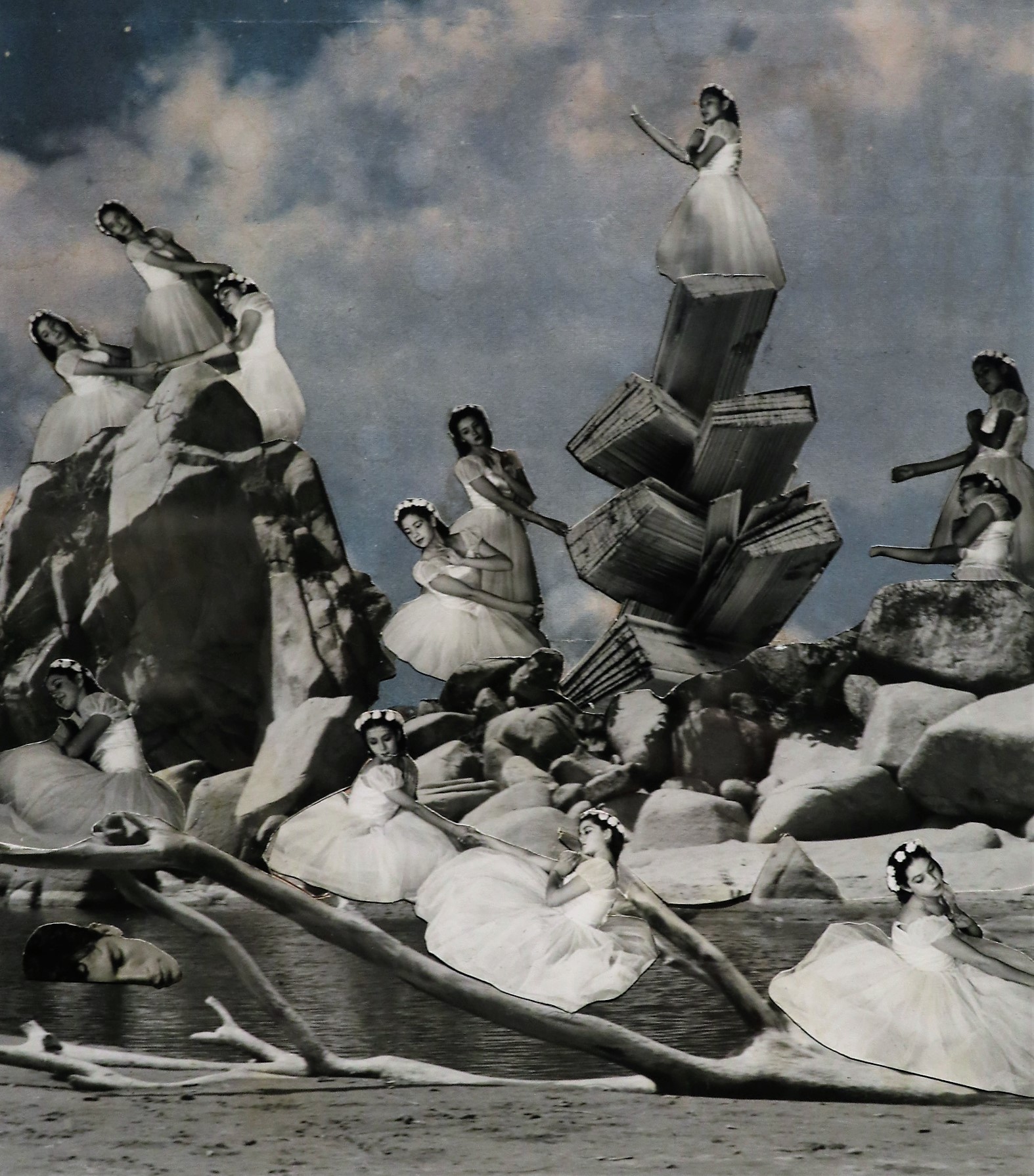
The Dream of the Drowned - Photomontage - Lola Alvarez Bravo - 1945
 
Photomontage is the process and the result of making a composite photograph by cutting, gluing, rearranging and overlapping two or more photographs into a new image.  Sometimes the finished "collage" is photographed so that the final image may appear as a seamless physical print.   Lola combines parts of her photography, the face of the Painter Juan Soriano floating in the water along with the dancers of the Ballet de Folkorico de Mexico City.  This real and fantasized world is a quality shared by the surrealism movement.
Ruth Rivera Marin - Veracruz - Lola Alvarez Bravo - 1950

Ruth Rivera Marín was born in Mexico City on 18 June 1927 to parents Diego Rivera and his first wife, Guadalupe Marin Preciado,  a well-known actress and writer. 
Ruth was the first woman student of the College of Engineering and Architecture at the National Polytechnic Institute and her career centered on teaching the theory and practice related to architecture.                                                                                                                                      
Mexican Landscape II - Photomontage - Lola Alvarez Bravo - 1950

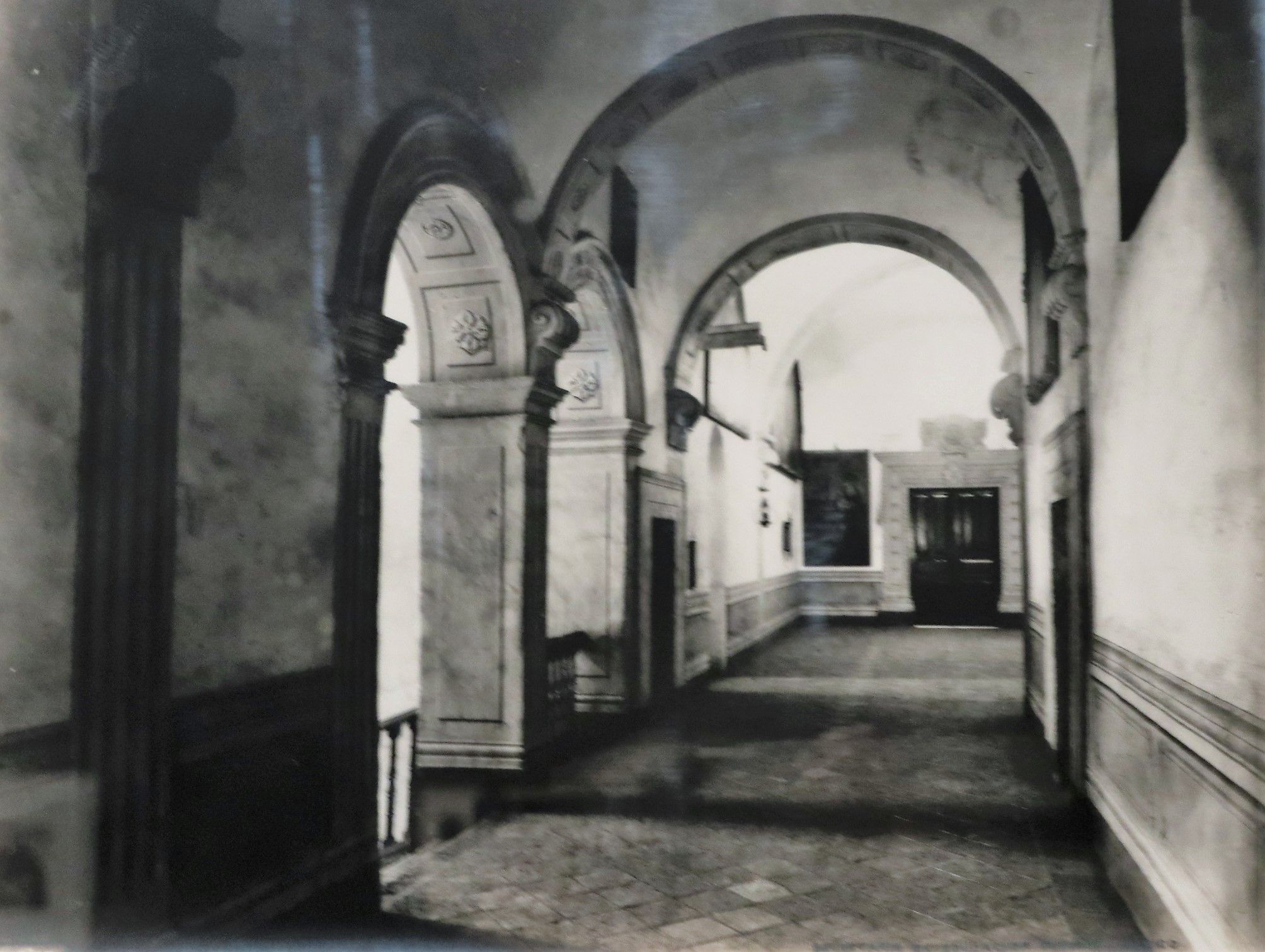
Tepotzotlan - Hall of Convent - Guillermo Kahlo - 1920's

Wilhelm (Guillermo) Kahlo (Frida's father) was born in Germany in 1871 and later moved to Mexico City in 1891 where he had his own photography studio, specializing in buildings, room interiors, factories and machinery.  Upon his arrival he changed his name from Wilhelm to Guillermo.  Following some commercial success, he was commissioned under the regime of Porfirio Díaz, President of Mexico in the early 1900s, to document the country's colonial architecture, government buildings, infrastructure, landmarks, monuments, streets and churches.

 Mexico City's Cathedral - Choir Stalls - Guillermo Kahlo - 1920's

Photography played a huge role in documenting the political events during the Mexican Revolution (1910 – 20).

  
Bell Tower - Guillermo Kahlo - 1920's

In the 1920's Guillermo's church photographs were republished in six volumes titled Iglesias de Mexico / Churches of Mexico.   His photography was no longer seen simply as monuments to European religious tradition, the churches he captured were reinterpreted for their vernacular qualities and the role of the indigenous workers who built them. 

Frida Kahlo Wearing a Plaster Cast - Florence Arquin - 1950
 
Painter, photographer, educator, writer, and critic, Florence Arquin (1900-1974) was active in Chicago, Illinois.   She was widely known for her expertise in the field of Latin American Studies and had a close relationship with Frida Kahlo and Diego Rivera.

 
Seated Frida in Her Hospital Room with Photographs - Lola Alvarez Bravo - 1940's
 
 
 Frida Kahlo in a Wheelchair with a Sun Umbrella - Florence Arquin - 1950's
 
Frida Biting Her Necklace - Lucienne Bloch - 1933
 
Bloch was born in 1909 in Geneva, Switzerland.  She was the youngest child of composer and photographer Ernest Bloch.  In 1917, her family immigrated to America.  She was a prolific artist.  At 15 years old, she attended The Cleveland Institute of Art and later in life enrolled in the Ecole National et Superier des Beaux Arts in Paris.  
In 1929, she pioneered the design of glass sculpture for the Royal Leerdam Crystal Glass Factory in the Netherlands and that caught the eye of Frank Lloyd Wright.  He invited her to teach at Taliesin East where she worked beside fellow artists.
In 1931, she met and began her apprenticeship with Diego Rivera on his frescoes in New York and Detroit.   She formed a close friendship with Frida and they became each others companion and confidant.  She accompanied Frida to Mexico when Frida's mother became ill and was with her in Detroit when Frida suffered a miscarriage.  
An established photographer, she took the only existing photographs of the Rivera's mural, Man at the Crossroads in Rockefeller Center in New York City before it was destroyed.  She also contributed many photographs of Frida and Diego to biographical works about them.
Bloch married one of Rivera’s chief plasterers, Stephen Pope Dimitroff and together they created Fresco murals all over the United States.  Bloch was a Fresco muralist for the Federal Arts Project of the Works Progress Administration from 1934-1939. 
 
 
Frida Kahlo Leaving the Church in Coyoacon - Fritz Henle - 1937

Fritz Henle (June 9, 1909 – January 31, 1993) was a German-born photographer, known as "Mr. Rollei" for his use of the 2.25" square format film used in the Rolleiflex camera.  It was Frida who invited Henle to her home, Casa Azul in Coyoacon, several times to photograph her.
He photographed fashion, portrait, travel and industrial subjects and his work was published by Life,  Mademoiselle, Town & Country and Harper's Bazaar magazines. 

Frida Kahlo - Imogeen Cunningham - 1931

Imogeen Cunningham was born in 1883.  She was an American photographer who was best known for her portraits and her images of plant life.

In 1930, Frida and Diego moved to San Francisco where Diego was working on two separate murals.   That is where Kahlo met Cunningham.  Cunningham captured the essence of Frida with her calm, pensive gaze into the camera dressed with the traditional Mexican shawl (reboza), her jewelry and hairstyle.

Kahlo, known for her self-portraiture, was acutely aware of how she wanted to be portrayed photographically. She once said, “I knew a battlefield of suffering was in my eyes. From then on I started looking directly at the lens, unflinching, unsmiling, determined to show I was a good fighter to the end.”

Also,  she “ … effectively manipulated her self-image before the lens through her gaze, pose, and the carefully constructed symbolism of her clothing, jewelry, and hairstyles.”


DENVER ART MUSEUM

 Exhibition runs thru January 24, 2021

Friday, September 23, 2016

The Mexican Cook Book from the 1970's , written and photographed by George and Inger Wallace is a real gem

I bought this cookbook when I was in college right when it was published in 1971.  The recipes are straight forward,  somewhat elementary.  The authors traveled throughout Mexico and put together a collection of their favorite Mexican recipes and adapted them for the American kitchen.  Things have changed drastically in what ingredients one can find now verses back then.  But the thing I like best about this small cookbook is the photography.
First let me tell you a little about the George Wallace...  Born in San Francisco, he excelled in two completely different fields, speed skating and photography.  
He was the only American athlete to compete independently in the 1940 World Games (later known at the Olympics).  He won top medals in Latvia, competing in minus 40 degrees Celsius weather!
In 1939 he was invited by the Oslo Skating Club to train on their outdoor rink and that is where he met his future wife, Inger Dalhberg.  Fleeing Norway after the German occupation, they were fortunate to get the last available passage on the U.S. Manhattan.
Back in the states, he worked for his family's company, US Pipe Mfg..  
He was passionate about photography since the age of 12.  In the late 1940's, he was a full time student on a scholarship for two years under Ansel Adams, Minor White and Edward Weston.   He later became a professor of photography and created a simple hand calculator   to determine the best DOF, depth of field.  He had a knack for shooting from the hip which was useful when shooting in Mexico where the people were standoffish of having their photo taken for they believed the photograph would steal their spirit.  He would engage his subjects in friendly conversation which led to mutual respect which show in the images below.  You can see this in his photos, for many of his subjects have a smile on their face and a twinkle in their eyes. 
He shot with minimal equipment using natural light and sometimes a mini-tripod.
He invented the ExpoDisc.  This disc, like a lens, sets the white balance on the camera enabling the photographer to capture accurate color when clicking the shutter.  Good color and exposure saved the photographer tremendous time from having to make adjustments on the camera's settings and less time in the dark room.  
Most of his photographic archives were destroyed by a fire in 1989, but negatives and slides from Mexico and Norway were spared.
Enjoy some of the photographs below that I scanned from the cookbook along with the copy that accompanied the photo.
"This is one of the three large bands of musicians in Teotitlan del Valle, a Zapotec village in the state of Oaxaca.  These bands provide all the music for the local religious festivals and pageants."   Teotitlan del Valle is one of the villages that I take my group to and is renown for it weaving of rebozas and rugs.
"Their work in the fields caught up and the rainy season begun, mestizos from San Juan Chilateca wait for a ride to the nearby fiesta where they will earn extra money as professional musicians."
"Many men of nearby Santa Catarina Minas share work provided by stills hidden in remote barrancas of this desolate region.  From these stills comes the best mescal in all Mexico."
"Largest of all Indian markets of Mexico, the Oaxaca market is within a day's travel of every conceivable combination of soil, climate and topography, and therefore features an exotic and great variety of fruits and vegetables throughout the year."  And to this day, the market has not changed that much.
"Indians and mestizos alike converge on the large market on Saturdays.  They come from lonely huts in the hills and nearby villages to buy, sell and barter; and to enjoy the excitement of the market place."  The women today still wear their shiny black hair in a handsome braid and always wearing an apron and a reboza as they effortlessly balance their basket full of vegetables on their head. 
"These girls from San Felipe, A Zapotec village on the outskirts of Oaxaca, have just finished a part of their day's work.  Up long before dawn, they ground corn, made tortillas, ran barefoot to market with their wares loaded in baskets and sold hot, fresh tortillas to waiting customers."  I love these baskets and I buy one or two every time I am in Oaxaca. They are beautifully crafted.  Being pliable, I put one basket inside the other , pack my clothes in them and put the the baskets in my big duffle-shaped suitcase.  Back home, I use them for cloths hampers and waste baskets.
"On their way home from Mass, these women and children had been waiting in a small store for a momentary downpour to pass."  I have been there!  Some of the whiteout downpours in the state of Michoacan are unbelievable. 
"With methods as old as the Conquest itself, the women of Teotitlan de Valle spin yarn for woolen serapes for which their village is so famous."  A practice still done the in the old tradition.  And I have purchased the most beautifully woven serape that Ralph Lauren would have loved to showcase in his store.
"This vanilla bean farmer in Papantla, on the hot and humid Gulf Coast, prefers traditional Totonac dress for himself, but indulges in factory-made clothes for his children."
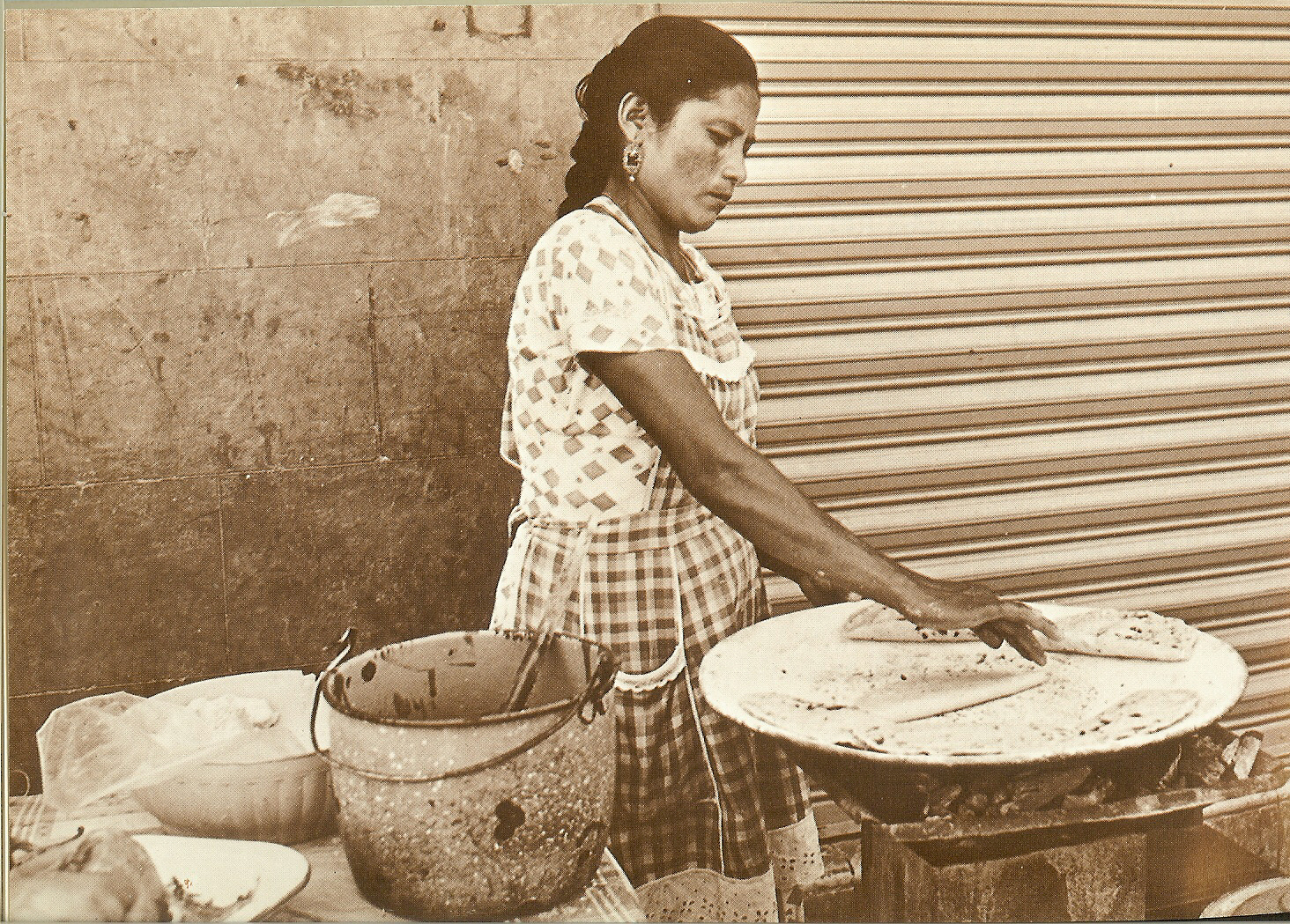
"This mestiza woman is one of many independent small businesswomen preparing and selling antojitos in the streets surrounding the huge Oaxaca market.   A scene very typical of today with the large clay comal used to cook the tortillas and the enamel pot probably filled with a salsa, freshly chopped nopales (cactus pads) or a mole...
"Refugio Masqueda Mercedes Chaves makes charcoal from the hardwood he gathers in the hills above Guanajuato, then hauls it down by burro to sell in the towns.  His strongly Spanish features are evidence of the harshness of the occupation that followed the Conquest of Mexico."  Don't you just love his name?  There were countless times when there would be a knock at our home in San Miguel de Allende with a man with similar looks and his burro loaded with firewood or bags of dirt for the garden.
"The timorous Tarahumaras only slip down from their primitive caves and huts to attend Mass, watch a Baptism or an occasional marriage ceremony, or seek medicine our counsel from the padre on his monthly visit.  He is the only outside they trust."  
Their way of life has not changes since the 1970's.  My next tour may involve taking the scenic train trip through the Copper Canyon where these interesting people live.  The Copper Canyon makes the Grand Canyon in Arizona look small in comparison.  


The Wallace's captured the warmth and spirit of the Mexican people and that is something I have experienced every time I have ventured out to explore some small village in the remote areas of Mexico.  Such gracious, friendly people.

The Mexican Cook Book is still available and I know you can find it on Amazon.  It's beautifully written, the recipes are easy and the photography is spectacular.