Fulang-Chang was a spider monkey that Diego gave her as a gift and a surrogate for the child she was unable to bear.
Self-Portrait with Monkeys - Frida Kahlo - 1943
Rivera saw Frida as "the personification of all national glory," referring to her outward appearance and her entire artistic body of works. She painted the flora and fauna typical of Mexico; cacti, Birds of Paradise, monkeys, parrots, deer and Itzcuintli dogs - animals she had as pets. These pets appear in many of her paintings, companions of her solitude.
The monkeys are being little rascals, peering out from the leaves and pulling at her blouse with their disturbing long arms. Even though the monkeys seem to mock her, her steely gaze indicates that she has attained an emotional distance from her situation.
Her top is a Huipil, an indigenous blouse. The red design, the Aztec symbol Olin, represents perpetual movement. Something she can identify with, her own personal and political turmoil in her life.
Landscape with a view of San Jose Purua - Diego Rivera - 1948
What a gorgeous countryside. In the early 1940's, San Jose Purua in the state of Michoacan in Mexico had one of Mexico's most luxurious spa hotel noted for its thermal springs with healing qualities.
I found this old photo of the hotel, I wonder if Frida and Diego stayed here. This is also the region where director John Huston filmed parts of "The Treasure of the Sierra Madre", starring Humphrey Bogart, in 1947 (he used the San José Purua Hotel Spa as his base)Great use of colors in the gallery space that really showcased the art.The Healer - Diego Rivera - 1943
After mostly completing the murals in the main stairwell of the National Palace in 1935, he dedicated himself to easel painting. He depicted customs and scenes of everyday life.
Sunflowers - Diego Rivera - 1943
Indian children were a particular interest to American buyers and these small works were easy to transport. He almost mass-produced them to sell to many tourist in order to procure funds to support his his growing pre-Columbian collection.
Nativity - Olga Costa - 1948
Originally from Germany, Costa's family escaped to Mexico City. She was inspired by Diego's murals and his pallet of colors. Once married, it was her husband, an artist/muralist, who encouraged her to paint and Olga was one of a number of prominent female artists in 20th century Mexico.
I like how the Holy Family stands on top of the hill with all the elements of Mexican identity are below; cacti, agave plants and the indigenous people in their native dress carrying corn. This Mexican identity, also known as Mexicanidad, centers around the
indigenous native and national heritage, showcasing the traditional
dress and furnishings.
The Pottery Shed at Talavera, Coyoacan - Leo Martiz - 1946
(April 1, 1917 – October 24, 1998)
Martiz was a Colombian photographer, caricaturist, newspaper publisher, painter and gallery owner. In 1951, Matiz's gallery hosted the first exhibition of Colombian artist, Fernando Botero.
Frida with Objects on Shelves - Bernard Silberstein - 1940
(Born 1905 in Duluth, Minnesota / Died in 1999 in Cincinnati, Ohio)
Silberstein built his international reputation doing assignments for National
Geographic, Life, Holiday, The New York Times, Time, Colliers, Esquire,
Popular Photography, The Camera and the Photographic Society of America
(PSA) Journal. His subjects included the king of Morocco and artists of
the Mexican muralist school. His photographs of Frida
Kahlo have appeared in several books on the famous artist.

Frida on Bench - Nicholas Muray - 1939
Frida had created her own identity, drawing attention
especially in the way she dressed and presented herself. She was fond
of wearing Tehuana outfits, the typical dress of the women in Oaxaca,
and wearing her hair in braids wrapped into a crown like style adorned
with flowers or colorful ribbons. She identified with the dress for her mother Matilde was from Oaxaca and had been photographed as a
child wearing the Tehuana dress. The traditional dress of the Tehuanas was known
nationwide to be the symbol of the most independent and proud
indigenous women in all of Mexico.
Frida with Blue Satin Blouse - Nickolas Muray - 1939
Nicholas Muray (15 February 1892 - 2 November 1965) was a Hungarian-born American photographer and Olympic fencer.
Frida with Red Rebozo - Nicholas Muary - 1939
Muray and Kahlo were at the height of their on and off again,
ten-year relationship when these pictures were taken. Their affair had
started in 1931, after Muray was divorced from his second wife, and
shortly after Kahlo’s marriage to Diego. It
outlived Muray’s third marriage, and Kahlo’s divorce and remarriage to
Rivera, by one year, ending in 1941. They remained good friends until
her death in 1954.
Frida with Olmec Figure - Nickolas Muray - 1938
Frida holds a jade Olmec figure. The Olmec were the earliest civilization known to have settled in Mexico, especially in the state of Tabasco.
Frida on the Roof-Deck of Nick's Flat - Nickolas Muray - 1946
Portrait of Diego Rivera - Frida Kahlo - 1937
Born in the capital of Guanajuato, Mexico in 1886. Frida had already seen Diego at the Escuela Nacional Preparatoria, where he had painted his first mural in 1922. She later went to see him in the Ministry of Public Education where he had been working on a mural since 1923. She wanted to see what he thought of her works. He was immediately impressed. They married in 1929, he being 21 years her senior.
For a bit more history on Frida and Diego, visit my post, Casa Azul in Coyoacan in Mexico City, dated October 9, 2020. Hopefully next October, I will be able to lead another tour to Mexico City and Casa Azul is certainly a special treat.
Self-Portrait with Necklace - Frida Kahlo - 1933
In 1932, Frida and Diego moved to Detroit where Diego had been awarded another commission. After three and half months, her second pregnancy ended in a miscarriage. Slowly overcoming this tragedy, this self portrait shows her wearing a pre-colombian jade bead necklace. A more confident Frida.
Portrait of Natasha Gelman - David Alfaro Siqueiros - 1950
One of Los Tres Grandes, he actually has a mural (unfinished ~ 1948) at the Bellas Artes School in San Miguel de Allende, the first art school in town where he was an instructor until his communist leaning created problems. He was extremely instrumental in the Mexican Mural movement.
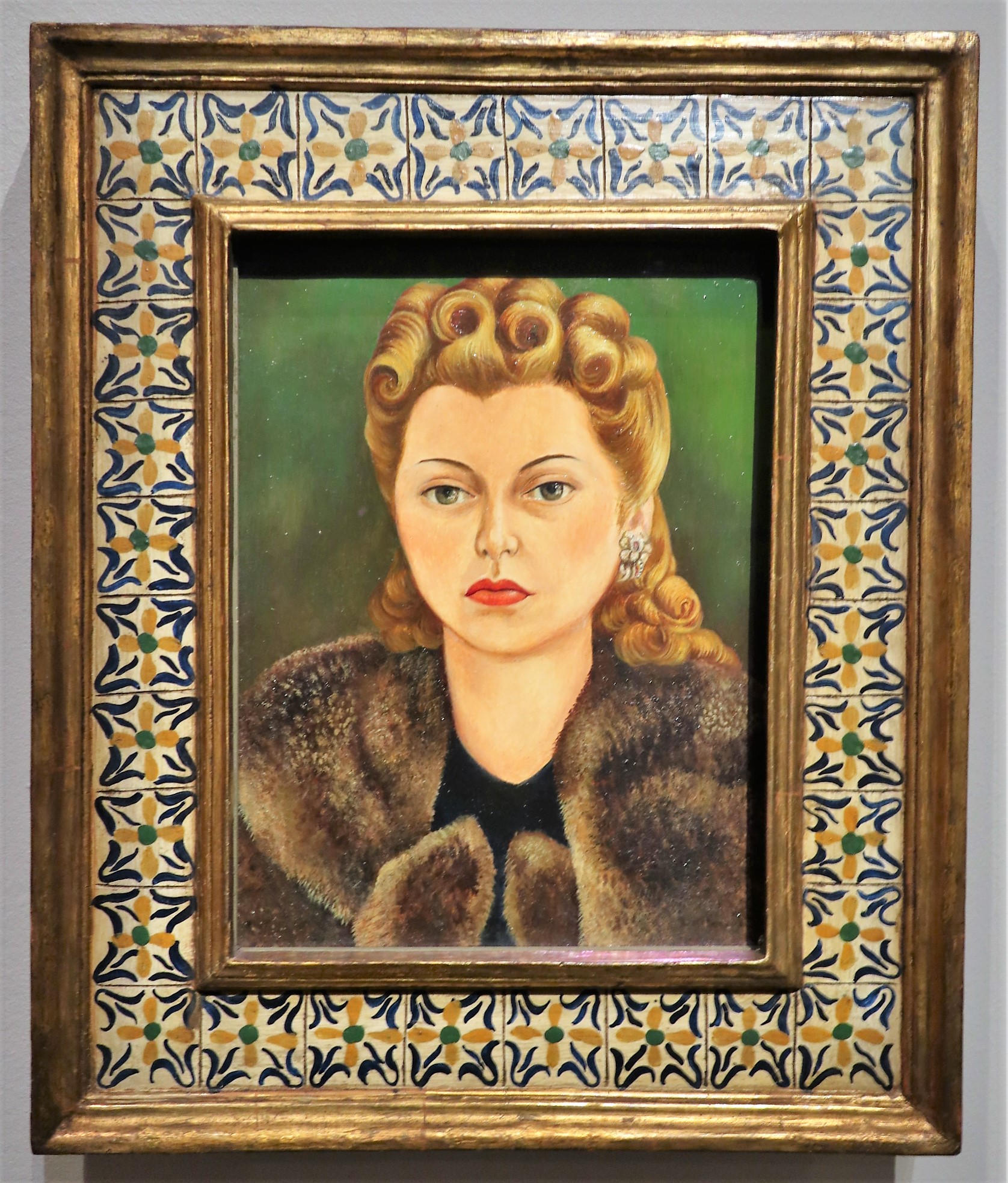
Portrait of Natasha Gelman - Frida Kahlo - 1943
The Gelman's commissioned both Frida and Diego to paint of portrait of Mrs. Gelman. Frida's portrays elegance and determination just in the look on her face.
Portrait of Natasha Gelman - Deigo Rivera - 1943
With the seductive Calla lilies, Diego captures her as a glamorous movie star.
One of Frida's life long friends, Lola Alvarez Bravo, the first Mexican female photographer. It was when she married Manuel Alvarez Bravo, the pioneer in artistic photography in Mexico, that she learned her trade. They were married for about nine years. She did not come into her own until her separation in 1934 and when she moved into the home of Maria Izquierdo. 
Portrait of Jacques Gelman - Gunther Gerzso - 1957
(June 17, 1915 - April 21, 2000)
Gertzo, born in Mexico City, was a painter best known
for his rectilinear abstractions. His work was greatly
influenced by Le Corbusier and Paul Klee. After studying in Europe, he returned to Mexico in 1931 and began his career as a painter while working as a set designer for Gelman's Mexican film production company, POSA Films. He also did set design for Luis Brunuel and John Ford, two decades of work and nearly 250 films.
He was also influenced by a purchase of a small pre-Columbian figure from an archaeological dig in Tlatico. As in the portrait above, he captures the spirit of the landscape. Octavio Paz has described Gerzo's work as "a system of allusions rather than a system of forms."
Four Bathers - Gunther Gurzso - 1940
(Born in 1915 and died in 2000 - Mexico City)
Totally different from his abstract portrait of Mr. Gelman.
Self Portrait - David Alfaro Siqueiros - 1830
(Born in Mexico City - 1896 / Died in Cuernavaca, 1974)
Portrait of Diego Rivera - Miguel Covarrubias - 1920
(November 1904 - February 1957)
Covarrubias was a Mexican painter, caricaturist, illustrator, ethnologist, anthropologist and art historian. He is also known for his analysis of pre-Columbian art of MesoAmerica, particularly of the Olmec culture.
I adore this caricature of Diego with his jaunty hat, oversized stature, the bulging frog eyes, the big lips, the pre-Columbian serpent vase , the ball-like cobblestones and the banners in the background.
Male and Female Figures - Nayarit, Mexico
The Diner - Rufino Tamayo - 1938
(August 1899 - June 1991)
Tamayo was born in Oaxaca, Mexico, an abstract painter and print maker influenced by his Zapotec heritage. He portrayed every day subjects like watermelons and animals. He moved to New York in the 1930's after a falling out with the politically driven Rivera and Siqueiros. He later returned to Mexico in 1959 where he founded the Museo Tamayo Arte Contemporaneo in Mexico City and the Museo Rufino Tamayo in Oaxaca. Both museums are spectacular and ones that I take my groups to.
The Diner speaks to me, the colors, composition... just wonderful.
Portrait of Natasha Gelman - Rufino Tamayo - 1948
Festival of the Birds - Carlos Merida - 1959
(Born in Guatemala City in 1891 - Died in Mexico City in 1985)
Merida
was one of the first painters to combine European modern paintings to
Latin American themes, especially those related to Guatemala and
Mexico. He was part of the Mexican Mural movement in subject matter but
less so in style for he preferred a geometric style verses a figurative
one. Like Tamayo, he was more interested in becoming a painter than
being involved in politics.
Variation on an Old Theme - Carlos Merida - 1960
Merida was also interested in music and dance which certainly influenced his paintings.
Man at the Crossroads - Man, Controller of the Universe - Diego Rivera - 1934 - Reproduction
Museo del Palacio de Bellas Artes - Mexico City
Diego was commissioned to paint a large mural in the lobby of the Rockefeller Center in New York. Thru his painting, he expressed views on the evils of capitalism and the positive aspects of socialism. As work progressed, he added a portrait of Lenin and other communist ideologies, figures not presented in his preparatory drawings. He refused to change the mural, he was paid off and released from his obligation. In 1934, it was completely destroyed but in that same year, he received a commission to paint the exact mural at the Museo del Palacio de Bellas Atres in Mexico City. Note: If you click on any of the images, it will go full screen.
In the center of the mural is a workman controlling the machinery. He is holding a giant orb, with four propellers filled with atoms and dividing cells. These "elongated ellipses" represent the discoveries made possible by the telescope and the microscope.
On the left, in between the propellers, wealthy women of high society are shown smoking and playing cards with a group of unemployed to the left looking on. Above are soldiers and war machinery. The other side portrays Lenin holding hands with multi-racial workers with a Russian May Day rally with red flags above. Each side has a gigantic statue; an angry Jupiter whose hand holding a thunderbolt had been severed off and a headless seated Caeser. This was Rivera's interpretation of contrasting social visions.
The bottom part shows a field of corn along with a variety of other plants, depicting controlled growth of natural resources.
Nude with Beads / Frida Kahlo - Lithograph - Diego Rivera - 1930
Very interesting on how Diego represents Frida, a body with void of any deformities.
Five Heads (Beggers) - Jose Clemente Orozco - 1940
(Born is 1883 in Guzman - died in 1948 in Mexico City)
Orozco was a caricaturist and painter and along with Rivera and Siqueiros, he help establish a national school of murals. He was the most complex of the Mexican Muralist, often fond of the theme of human suffering as seen above.
Bride from Papantla - Maria Izquierdo - 1944
Sitting in a typical painted, hand-carved wood chair, most likely from the wood carving town in Cuanajo in the state of Michoacan, the bride's soulful face almost looks like a mask. A colonial inspired wedding dress with a lacy veil. The nails enameled red along with the red lips that match the rebozo that she has in her lap is an added touch of modern-day feminine vanity.
Recreation of Archangels - Juan Soriano - 1943
(Born in Guadalajara in 1920 and died in Mexico City in 2006)
Soriano was a Mexican artist known for his paintings, sculptures and theater work. He had his first exhibition at the age of 15 where he was fortunate to meet Lola Alvarez Bravo and Maria Izquierda who encouraged him to move to Mexico City. Like Izquierda's works, the painting above is almost dream like in which normal events take on a mysterious menace.
Burial at Yalalag (Oxaca, Mexico) - Lola Alvarez Bravo - 1946
The hallmarks of photography during the Modernism Movement were abstraction, asymmetry, contrast and sharp focus, usually preferring to shoot in black and white and images of everyday life.
One of Lola's most iconic images was Burial at Yalag. A somber scene, a funeral procession of Zapotec women in their traditional dress accompanying a coffin. The contrast of the white flowing dresses and the dark landscape is very moving. It's also a statement of the women's lack of individual identify as they are not amongst the men in the procession.
She once said, “If my photos have any value, it's because they show a Mexico that no longer exists.”
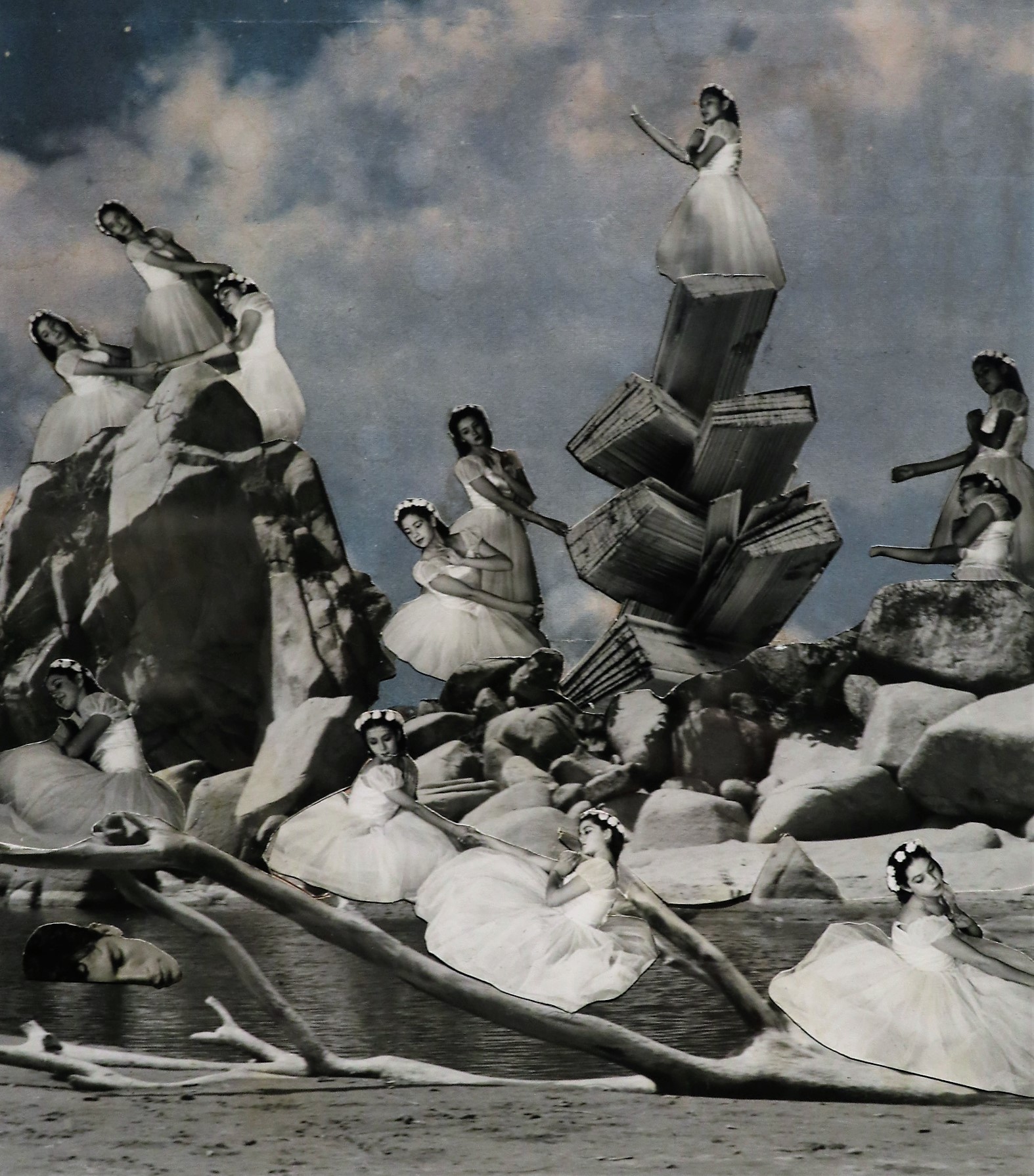
Mexican Landscape 1 - Photomontage - Lola Alvarez Bravo - 1950
Photomontage is the process and the result of making a composite photograph by cutting, gluing, rearranging and overlapping two or more photographs into a new image. Sometimes the finished "collage" is photographed so that the final image may appear as a seamless physical print. What a combination of images: the rugged mountains and terrain, an ancient aqueduct, an Aztec or Maya ruin, contemporary buildings, a stone column with a statue... Wish I knew more about the individual objects.
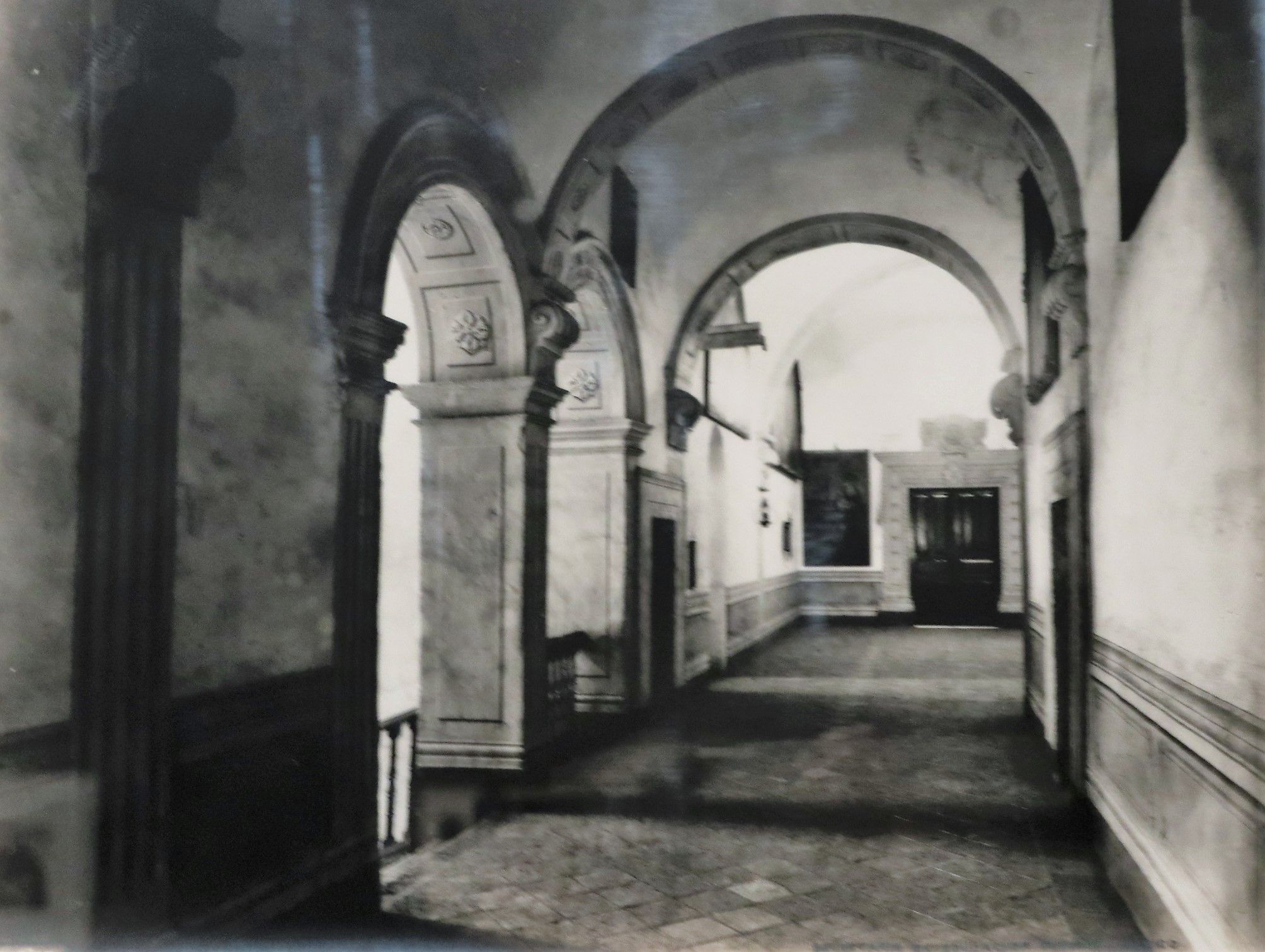
I was going to return to the show last week, but due to the mandate by the governor, the size of the groups admitted to public spaces has been reduced. I was planning to shoot and record more of the black and white photos by Lola Alvarez Bravo, Manuel Alvarez Bravo and Frida's father, Guillermo Kahlo. I am set to return to the exhibition in December and at the time, I will write another post on my Blog, more in depth on the photography. Tepotzotlan, Hall of the Convent - Guillermo Kahlo
Mexico's Cathedral, Choir Stalls - Guillermo Kahlo
Portrait of Jacques Gelman - Angel Zárraga - 1945
(Born in Durango, Mexico in 1886 and died in Mexico City in 1946)
Zárraga attended the Escuela Nacional Preparatoria in Mexico
City and the Escuela Nacional de Bellas Artes. In 1904 he studied in Europe, where he visited and
exhibited in Spain, France, and Italy.
From 1914 to 1921, his work was in a Cubist style, but
after 1921 his work became influenced by the painting styles of Paul
Cézanne and Giotto di Bondone. In Paris, Zárraga painted a series of murals at the Château de
Vert-Cœur, in the Cité Internationale Universitaire de Paris and at the
Mexican Embassy.
In 1941, with the outbreak of World War II, Zárraga returned to Mexico, where he painted murals at the Club de Banqueros
and in Monterrey Cathedral, the main Catholic church and the home of
the Archdiocese of Monterrey.
At the exhibition, there is a film clip from the famous movie, Maria Candelaria. A film starring Dolores del Rio with a flash back to Xochimilco, Mexico in 1909 right before the revolution. Maria Candelaria was the first Mexican film to be screened at the Cannes International film festival and in 1946 it won the Grand Prix. Maria del Rio was also a frequent visitor to Casa Azul. For more on the beautiful Xochimilco, see my post, "An afternoon on our own trajinera in Xochimilco" dated November 15, 2019. I think you would enjoy it.Circus Scene - Maria Izqueirdo - 1940
The circus scene is almost dream like with the ballerina sitting on a hurdle blowing a trumpet while an acrobat is standing on a horse as it jumps over the hurdle. Octavio Paz described her works perfectly, " reality becomes ghostly, and ghosts during the nights of disturbing dreams are incarnated in horses of powerful and melancholy sexuality."
Frida and Dr. Juan Faril - Gisele Freund - 1951
(Born in Berlin 1908 - Died in Paris in 2000)
Frida said that after seven operations on her spine, Dr. Faril save her. Like Frida, Dr. Faril , was also disabled and could only walk with the aid of his crutches. In this photo, Kahlo holds her palette, showing strength and determination.
Self-Portrait on Bed - Frida Kahlo - 1937
Appearing rather detached, Frida is sitting on a child's bed, smoking a cigarette. The doll is a surrogate for the children she could not bear.
The dresses and jewelry on display are representations of what Frida wore. So elegant.The traditional dress of the Tehuanas, symbol of the most independent and proud
indigenous women in all of Mexico.The lace work is just exquisite! A Tehuana design with the lace collar and headdress. As seen in the last self-portrait on my post.The Bride that Becomes Frightened When She Sees Life Opened - Frida Kahlo - 1943
(La Novia que se espanta de ver la vida abierta)
Like many of the ex-votas she liked to paint, this self portrait is very much like one, telling a story, especially with the name of the piece painted at the bottom. It is somewhat unsettling. First you gaze on the fruit, the course hair of the coconut's shell, the reddish-orange bananas, the wavy leaves of the pineapple stock, the juicy, beautifully sliced watermelon... The title mentions a "bride." In the upper left corner, the bride is a doll peeking around part of a watermelon. It is a doll that she had bought in a Paris flea market, using "found objects' in one's works is very surrealist. Included in this still life is a grasshopper perched on the bananas and a gloomy owl looking out. The fruit is somewhat sexual and alive where the animals are rather ambiguous. This still life is a journey, it suggests that innocence is about to be lost, but to not turn away from life but embrace it.
Living Nature - Maria Izquierdo - 1948
A different feeling is present in this still life. Spanish term for still life is "naturaleza muerte", or in English, "dead nature." The food is abundant but has seen better days, all arranged in a desolate environment.
Self-Portrait with Braid - Frida Kahlo - 1941
Frida cut off her hair, an expression of the pain she suffered from divorcing Diego. In this self portrait, she expresses her feelings after her remarriage to Diego. Combined plaited rope and strands of her hair that she had cut off seem to have a life of their own. The curly vegetation, like snakes, engulfs her body. This self portrait is a symbol of her reconciliation with Diego and her femininity which she had rejected when she divorced Diego (cutting off her hair and in dressing dark pant suits).
Diego on My Mind or Self-Portrait as a Tehuana or Thinking of Diego - Frida Kahlo - 1943
Frida depicts herself in an elaborate headdress worn by the Tehuana women, a piece of clothing that Diego loved. The image of Diego on her brow indicates the obsessive love she had for him. The roots of the leaves in her hair are like spider webs, a way of trapping her prey, Diego. But the expression on Diego's face is one of indifference, referring to his indifference when it came to Frida's feelings about his numerous affairs.
In Sara Lowe's book, Frida Kahlo, she points out that image is very similar to the Catholic "crowned sister" paintings that celebrate a nun's entry into monastic life. The nuns are also depicted wearing a crown of flowers. On one hand the nuns are becoming brides to Christ where as Frida is the bride to Diego, the cause of both joy and suffering in her life.
Not all 95 pieces of the Gelman collection are on display and to truly appreciate the exhibition one should have a little knowledge of the history of Mexico, the revolution which ended in 1920 and its indigenous culture. The show lacks information on the individual artists and insight on the paintings but that might have been a way to keep the crowds moving through the galleries during this pandemic. I hope you have enjoyed my post.
 DENVER ART MUSEUM
Tickets available on line
Exhibition runs thru January 24, 2021