Thursday, February 6, 2020

The Dolored Olmedo Patino Museum - Part Two

The Dolores Olmedo Patino Museum has 145 works by Diego Rivera and 25 by Frida Kahlo.   The progression of works start with the post-impressionist period, to the cubist phase, sketches and paintings for Rivera's MoMA show in 1931-2 to portraits and on to Rivera's later years when in Russia.
Self Portrait with Small Monkey
Frida Kahlo
1945
At the age of 38, Frida had created her own identity, drawing attention especially in the way she dressed and presented herself.  She was fond of wearing Tehuana outfits, the typical dress of the women in Oaxaca, and wearing her hair in braids wrapped into a crown like style adorned with flowers or colorful ribbons.   In this self portrait, she is with her favorite pets, Senor Xololt, a xoloitzcuintle dog, and Fluang Chang, a spider monkey.
Self Portrait with Broad-Brimmed Hat
Diego Rivera
1907
Rivera adapted this style while studying at the Eduardo Chicharro atelier, a Spanish master with whom he studied at his arrival to Spain at the age of 21 in 1907.
Frida and Diego
This entire wall displays effigies known as Colima dogs, depictions of the Xolos in terracotta.  These dogs were found buried in ancient tombs through out Mexico.  They were used to protect and guide the deceased spirit through the perils of Mictlan and also serve them in their afterlife.
El Picador
1909
Diego Rivera
A painting of a Spanish bullfighter seated slightly of center against a neutral colored wall.  Similar to his self portrait, the brush strokes really show off the texture of the fabrics by using the impasto oil technique.
El Matematico - The Mathematician
Diego Rivera
1918
Rivera considered this to be one of his most important works.   The proportions and disproportions works beautifully.  The colors, lightening and shadowing is everything he learned when studying at the Eduardo Chicharro atelier along with the influences left by post-impressionism, Spanish realism and Costumbrismo and cubism.. 
Boceto del Fusilamiento a Maximiliano
Sketch of  Execution by Firing Squad of Maximillian
1935
Diego Rivera
Once the hacienda's chapel, this room houses preliminary sketches and works for his large scale murals.  Above is a preparatory work by Rivera for the mural he painted in the National Palace in Mexico City.  An old technique, made in sepia ink on paper, this stencil technique was used by artist like Michelangelo.
Fondos Comgelados
Frozen Assets
1931
Diego Rivera 
 Rivera produced eight portable murals for the MoMA, The New York Museum of Art, in 1931.  Frozen Assets represents life in New York City during the Great Depression which is divided into three sections.  The top section is that of the great skyscrapers of New York City  with such buildings as the Daily News, Bank of Manhattan, Rockefeller and Chrysler, a reference to the economic development and Capitalism.     The middle section is a large glass and steel structure filled with sleeping men or corpses, a homage to the unemployed overseen by a guard.  The bottom section, a large bank vault with those seated are waiting to examine their earnings.  Maybe guarded by the same guard.  It was a journalist who was covering the exhibition that gave the name for this work, Frozen Assets.
A handsome room with the hefty wood beams and corbels.
Retrato de Dolores Olmedo (La Tehuana)
Portrait of Dolores Olmedo (The Tehuana)
1955
Diego Rivera
A beautiful example of Mexican textile design with Dolores attired in the colorful Tehuana.  The Tehuana was a popular mode of dressing in the 1930's and 1940's among the wives and models (muses) of painters, musicians and writers.
Frida adopted the Tehuana dress as her signature look.  She identified with the dress for her mother Matilde was from Oaxaca and had been photographed as a child wearing the Tehuana dress.  And the traditional dress of the Tehuanas was known nationwide to be the symbol of the most independent and proud indigenous women in all of Mexico.
A typical colonial kitchen with the Talavera tiles and large cazuelas. 
The swallow bird motif hand-painted tiles from Puebla.
Naturaleza Muerto (Soy de Samuel Fastlicht)
Still Like (I Belong to Samuel Fastlicht)
1951
Frida Kahlo
Frida painted this still life for their friend and dentist, Samuel Fastlicht, a man of European origin who arrived to Mexico in 1921.   He was deeply interested in pre-Columbian history particularly in the areas of dental mutilation and herbal medicine used by the ancient Mexican cultures.


Beautiful Mexican ceramics.
I could have a full room of these.  From Tonala in the state of Jalisco.
Retrato de Irene Phillips Olmedo
Portrait of Irene Phillips Olmedo
1955
Diego Rivera
Rivera and Dolores Olmedo renewed their friendship in 1955 and she commissioned him to paint a portrait of her daughter at his studio in the San Angel.   Only the great masters like Rivera could paint with this effect of poly-angularity, the subject looks at the viewer from every angle she's seen from.  I had a photo I took of a Mexican artisan that hung in the hallway of my last house in Mexico.  And it did not matter where I stood, she was always staring at me.  I'll have to write about that on my next post.
La Columna Rota
The Broken Column
1944
Frida Kahlo
Every detail of Frida's shattered column is associated with pain from her accident; the nails and tacks on her body, the corset holding her exposed body together, the tears running down her face...  The background is void of vegetation with a blue sky, a symbol of hope that her health will improve.
Sin Esperanza
Without Hope
1945
Frida Kahlo
A tragic scene with Frida lying in bed, crying from the pain and rejecting the food that the doctors wanted her to consume to get better.  The large funnel is supported by a similar wood easel that her mother had made for her.
El Camion
The Bus
1929
Frida Kahlo
A recognition of the scene in the bus just prior to her tragic accident.  
Seated is a middle-class woman, a worker, an indigenous woman, a young boy, a young man and an eighteen year old Frida.  In the background one particular building was called La Risa (Laughter), an ironic statement on what was about to happen next.
Auterrstroto de Diego
Self-Portrait of Diego
1954
An expressive self-portrait of a sixty-eight man with his protruding eyes which earned him the nickname "The Frog Painter" or "The Great Lord Toad".  He often mocked himself by drawing little frogs or toads on his letters or documents.  1954 was a very difficult year for him, the death of Frida Kahlo and a diagnosis of his cancer.  
Dedicated to his daughter Ruth, the inscription in the lower left corner reads: "Para la Chupulina de esta cara fea, Diego Rivera, 1954" ~ "To the grasshopper of this ugly face, Diego Rivera, 1954."
La Nina Virginia
Little Virginia
1929
Frida Kahlo
Frida captured the innocence of this indigenous child.  The image certainly resembles Frida.
Mujer con Flores
Woman with Flowers
1938
Diego Rivera
Rivera rarely painted using pastels due to problems with his eyes.  Beautifully executed, a mestizo woman carrying a bouquet of marigolds in preparation for the Day of the Dead celebrations.
Vendedor de Coles
Cabbage Seller
1936
Diego Rivera
A vendor walking through the tiangus, street market, offering his goods.
La Hamaca
The Hammock
1956
Diego Rivera
A portrait of Dolores Omedo's daughter, Irene and her school friend, lounging in a hammock at Dolores's Acapulco home with the Acapulco bay in the background.

A beautiful collection of works by Frida and Diego!

MUSEO DOLORES OLMEDO PATINO
Avenida Mexico 5843
La Noria
Xochimilco 

Tuesday - Sunday
10am - 6pm


Tuesday, February 4, 2020

The Dolores Olmedo Patino Museum in Xochimilco in southern Mexico City - Part One


The Museo Dolores Olmedo Patino is one of my favorite museums to visit when in Mexico City located in Xochimilco, in the southern edge of Mexico City.    
Maria de los Dolores Olmedo y Patino Suarez (December 14, 1908 - July 26, 2002) was a Mexican businesswoman, philanthropist and musician.   And a good friend of Frida Kahlo and Diego Rivera.   She originally met Rivera when she was 17 years of age and he was in his forties.  It was when she accompanied her mother, a school teacher, to the ministry of Education, where Rivera was presently working on a mural.  It was then he asked her mother permission to sketch her.  Little did her mother know that those sketches of Dolores were in the nude.
In 1962 she purchased the 16th century hacienda, Hacienda La Noria (the water wheel estate).  In 1994 she converted her estate into a museum, donating her entire collection which included pre-Hispanic art, folk art, contemporary art along with one of the largest private collections of Frida Kahlo and Diego Rivera's works.
Here she is dressed in the typical Tehuana dress with one of her beloved Mexican hairless dogs by her side.
The grounds, beautifully manicured, are filled with native plants and flowers. 
  The massive blue agave are very impressive.
The grounds are home to many different animals.
Numerous peacocks, geese and ducks.
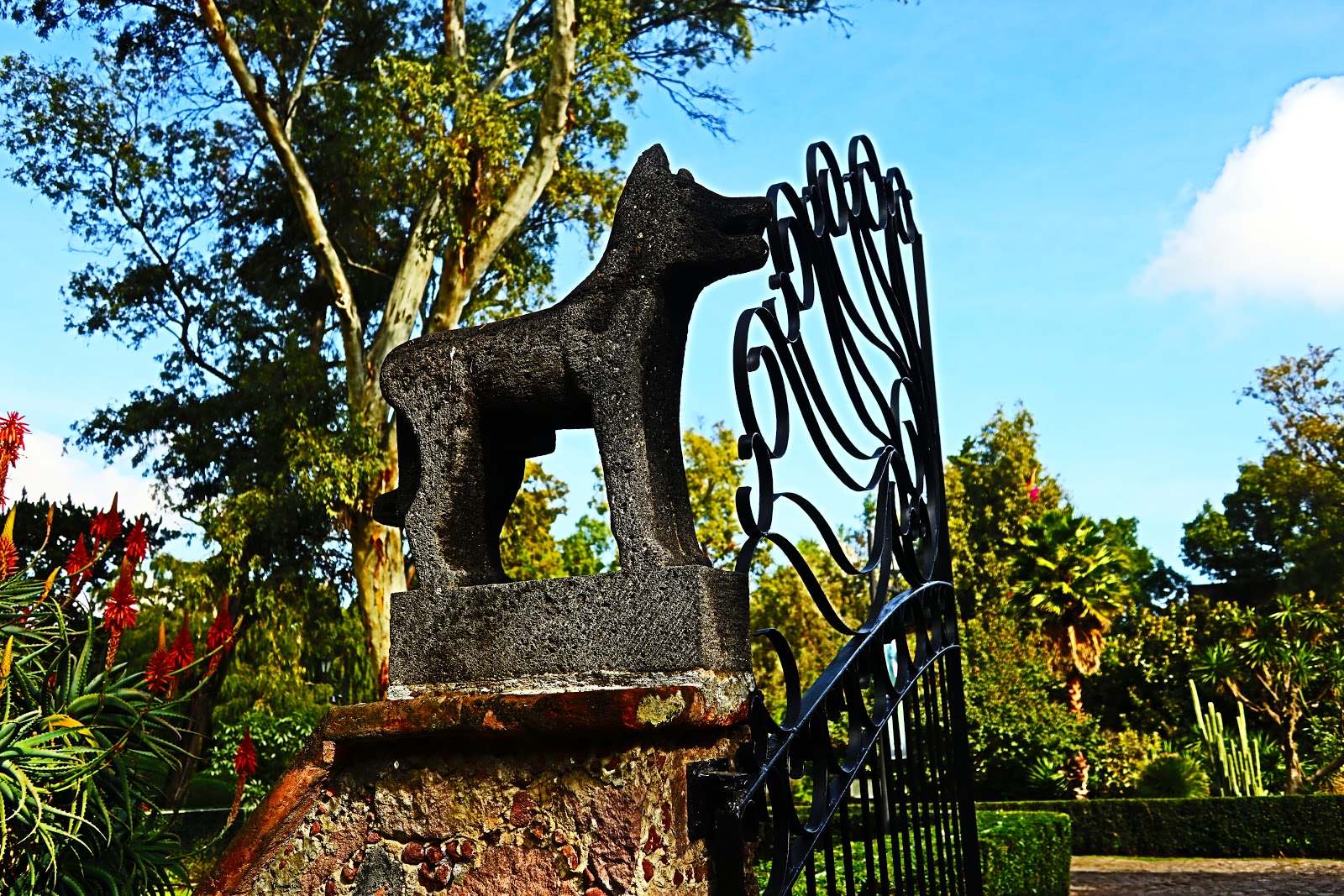
Not to mention the stone, bronze and live Xoloitzcuintli.
Also know as the Xolo, these dogs are descendants of a pre-Colombian breed of hairless dogs.  Their name comes from a combination of two Nahuatl words, the language of the Aztecs:  Xolotl (the Aztec god of lightening and death) and Itzcuintli (dog).   According to Aztec legend, the Xolo were to protect the living and guide the souls of the dead through Mictlan, the Aztec underworld.
La Noria is a five building complex with over 150 paintings, including 145 Rivera's and 25 Kahlo's along with 6,000 some pre-Hispanic figures and sculptures.

A patio with an impressive Olmec head from the state of Tabasco.
A goofy picture of me... an interactive piece.  
A copy of Frida Kahlo's "El Camion" (The Bus) - 1929.  Frida, seated far right, painted this as her recollection of the bus ride prior to her horrific accident.

The entire complex is beautifully maintained, the grounds, the buildings, the galleries...  A perfect place to spend the morning, away from the hustle and bustle of the center of town.  And there is a nice little coffee/snack bar where we (my group and I) sat on the patio and enjoyed a delicious cup of hot chocolate.

Look  for my next three posts which will feature the galleries, one centering on pre-Colombian pieces, ceramics and works by Kahlo and Rivera.  The second post will feature the lithographs by artist Pablo O'Higgins.  The third post will showcase some of the crafts and folk art from various states in Mexico and the vignettes of Day of the Dead ofrendas (offerings).  Now you can see why I  love this museum so much.

MUSEO DOLORES OLMEDO PATINO
Avenida Mexico 5843
La Noria
Xochimilco 

Tuesday - Sunday
10am - 6pm


Tuesday, January 14, 2020

Travel the Ages... From the colonial town of Puebla to the lavish culture of Mexico City


I have put together a phenomenal nine day guided tour 
Puebla City and Mexico City.
October 9 - 18, 2020

For those who have been on my San Miguel de Allende tours, my Artisan and Architecture tour in the state of Michoacan, Oaxaca tour and exploring the Magic of the Maya World in Chiapas, I know if you join me, Puebla and Mexico City will also capture your heart.  
Helping me on this tour is Rick Hall.  Rick has helped me with a few of my previous tours and he was recently selected by the Mexican Cultural Institute of Artisans to be a judge at all the expositions in the state of Michoacan in 2020!  He is a perfect choice for this honor for he has worked directly with numerous artisans in central Mexico over the past 40 years and his personal folk art collection is museum quality.  Rick helped me with my last tour to Mexico City and his knowledge of the history, artisans, the city, etc., was remarkable! 
The first part of the tour starts in Puebla.  You will fly directly from Denver to Houston and then on to Puebla.  Rick and I will meet you at the airport where we will be escorted to our hotel right in the historic center of town.  Once checked in, we will walk a few blocks to the zolcalo, the main square, for a light dinner under the portales.
Puebla is a colonial town loaded with Renaissance and Mexican Baroque architecture.  
A city famous for mole poblano, chilies en nogada, excellent dining and Talavera pottery.
 
 The first morning will be a walking tour of the historic center starting in the zolcal0
which is bordered on three sides by the original broad stone arcaded buildings (called portales).
and on the south side is the Cathedral.  The Cathedral, considered by many as one of the most beautiful in all of Mexico, was completed in 1648 with bells only in one tower with one bell weighing 8.5 tons.  
A visit to the Ex-Convento Santa Rosa, converted into a museum to display crafts produced in the state of Puebla.  The above is the former kitchen at the convent constructed with talavera tiles filled with huge caldrons and other earthenware utensils.  It is legend that the Dominican nun, Sor Andrea d la Asuncion, created the famous Mole Poblano.
A special guided tour at the renown Taller Uriate, a famous talavera pottery workshop where we will witness the whole production of the talavera pottery.
A stop at the Museo Bello with its eclectic collection of over 2,500 pieces of furniture, decorative arts, talavera pottery all collected by Mariano Bello, a 19th century industrialist who owned cigar and textile factories.
Tour the International Museum of the Baroque designed by Japanese architect Toyoo Ho followed by lunch in the museum's Restaurant Barroca.  Visits to the Museo Casa del Dean, a Renaissance-style home built in 1580 with phenomenal antique frescoes.   A stop at the Casa de Cultura, formerly the archbishop's palace with a facade adorned of bricks and tile.  Up a flight of marble steps to the second floor, you will encounter  the Biblioteca Palafoxiana, the oldest library in the Americas.
Dining in Puebla is some of the best.  One night we will dine at El Mural de Los Poblano, shown above.  Another night, at a private home owned by Pueblo's top antique dealers.  Lunch one day in the Cinco de Mayo Market.  And much more...
Our private van and driver will pick us up at our hotel in Puebla and we will be chauffeured to an old gem of a hotel, Hotel Geneve, right in the heart of the historic center of Mexico City.  
Arriving into Mexico City just in time for comida (lunch) where we dine in a funky cantina right in the center of the charming colonial Coyoacan district. 
After comida, we will immerse ourselves into the world of Frida Kahlo when we tour Casa Azul, Frida's gardens, studio and home.
 Frida's colorful kitchen at Casa Azul.   
 Another morning at the Plaza de la Constitucion, invariably known as the Zocalo, one of the biggest public squares in the world.  We will visit the National Cathedral, one of the greatest religious structures in Latin America, 
and the Templo Mayer, the site of the Aztec teocalli (sacred city). 
A visit to the National Palace, the former site of Hernan Cortes’ residence. 
The most interesting feature of this Renaissance building is the great mural by Diego Rivera depicting the history of Mexico along with countless other murals on the second floor. 
A stop at the Palacio de Correos de Mexico (the central post office) built in 1907 is quite spectacular with its eclectic architectural styles.  Pretty amazing.
The Palacio de Iturbide is one of the best colonial, Baroque buildings in the city.  Built around 1780, it was once the home of Augustin de Iturbide, the first emperor to Mexico after Mexico's independence from Spain.  Later it was a convent, a college and then a hotel before Banamex purchased it.  It re-opened as the “Palacio de Cultura Banamex” and today it hosts numerous temporary art exhibitions, as well as art workshops for adults and children.  The last exhibition was out of this world, who knows what will be in store for us next October.
Another morning we will start at the Museo de Culturas Populares, which has excellent temporary exhibits on Mexican culture and artists.  Comida at one of my favorite places, Los Danzantes, in the San Angel area.  After we will have plenty of time to explore the famous Bazar Sabado, an artisan market that comes to life every Saturday filled with stalls after stalls of handmade jewelry, textiles, crafts... 
Later we will have a leisurely dinner at the San Angel Inn.  The San Angel Inn is a long-standing, venerable institution in Mexico City.  Set in a classic, old hacienda (originally a convent), the atmosphere is elegant with blue-and-white Talavera-style place settings and bright white table linens—it has a true Spanish-Mexican colonial feel and is an oasis of calm in the middle of city.  A special place I have been coming to for over 40 years.
Comida one day at Contramar, famous for their fish and the decor is spectacular.  I love the brilliant blue wall along with the ceiling being covered in the Mexican straw mats, los petates.  It's a popular place.  Author and Chef Rick Bayless just featured Contramar and the San Angel Inn in his latest PBS series of, Mexico, One Plate at a Time with Rick Bayless.  Check it out, Season 12, Episode 6.
A full morning at the Museo Nacional de Antropolgia which houses a world-renowned Pre-Coloumbian collection.  The museum’s large, central patio is almost covered by a 275 foot canopy which sits on a 36 foot pillar, the largest concrete structure in the world supported by a single pillar.  Now that is what I call a fountain!
The collection in beyond description.  Not only is the collection magnificant, the building and gallery spaces are spectacular.
Cena (dinner) at Los Limosneros, a lovely restaurant that puts a contemporary twist on traditional Mexican cuisine.   The walls of this old structure date back to 500 years, part of the fortified walls built back in the days.
A visit to the Museo Dolores Olmedo, possibly the most important Diego Rivera collection of all belongs to this museum, ensconced in a peaceful 17th-century hacienda.
Dolores Olmedo, a socialite and patron of Rivera, resided here until her death in 2002. 
We will have a relaxing afternoon, touring and dining on one of the colorfully painted trajinera boats
at the floating gardens (Chinampa) in Xochimilco.  Xochimilco, meaning “Place of the Flowers” in Nahuatl is famous for its Aztec-made waterways surrounding the ancient city of Tenochtitlan, which is now modern Mexico City.


Another dinner in Mexico City will be at 99 Nueve Nueve.  Located on the gorgeous grounds of cultural center Casa Lamm, a Mexican Bistro with Chefs Luis Duran and Monica Beteta in charge of the kitchen where they create fantastic dishes with typical ingredients from all around the country. 


For more information, please email me your name and any other contact information and I will send you a complete itinerary along with pricing, a deposit request form and plane travel information.  I am limiting this tour to a maximum of ten and I already have five signed on for the trip.  The five signed on have been on most if not all of my other tours!

TRAVEL THE AGES...
FROM THE COLONIAL TOWN OF PUEBLA
TO THE LAVISH CULTURE OF MEXICO CITY

OCTOBER 9 - 18, 2020


robindsg@aol.com